Full-service, independent repair center
with experienced engineers and technicians on staff.
We buy your excess, underutilized, and idle equipment
along with credit for buybacks and trade-ins.
Custom engineering
so your equipment works exactly as you specify.
• Critical and expedited services • Leasing / Rentals/ Demos
• In stock/ Ready-to-ship • !TAR-certified secure asset solutions
Control Techniques Dynamics Limited
CT Dynamics is a British company renowned for its
innovations in the industrial servo, aerospace and defence
markets. Founded some 40 years ago it has developed a
leading position by combining two of the UK’s best servo
companies: Moore Reed and the Powerotor Division of
Evershed and Vignoles. CT Dynamics’ experience in the field
of servo and rotating components provides a strong base
from which to develop cost effective solutions for a spectrum
of applications from machine tools, mechanical handling,
pick and place machinery – through to specialised
mechanisms and actuators for the avionics industry.
CT Dynamics is a member of the Emerson group of the USA.
This gives the company access to a vast engineering design
resource in the USA, in the UK and in mainland Europe. As a
result CT Dynamics offers continuous advances in product
range, backed with the expertise and flexibility to meet the
demands of your applications – now and in the future.
Introduction
The Unimotor range has been developed following extensive
research and testing of thermal dynamic theories and
practices.
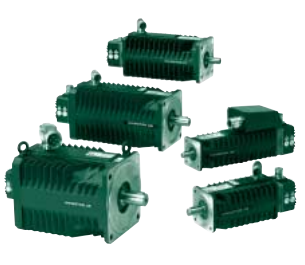
This range is available in five frame sizes 75; 95; 115; 142
and 190mm, in a unique and instantly recognisable finned
design that offers extra strength, rigidity and thermal
performance. These are important features for high
performance servo systems.
Designed to operate from switched-mode three-phase AC
drive outputs with DC link volts up to 750V DC, this range
employs a registered UL approved insulation system.
There are four basic motor types, each for different drives.
UM, SL and DM motors are for 400/440V nominal AC
drive supply voltage.
EZ motors have identical mechanical construction and
feedback options, but support a different winding to suit
220V nominal AC drives such as Unidrive LV and Epsilon /EN
drives.
UM, SL and DM Motors
UM Motor
The UM motor has been primarily designed to operate with
the Unidrive and Unidrive SP, but can be used with any
suitable drive.
Feedback options include resolver; or incremental, sincos
single-turn, sincos multi-turn optical encoders.
SL Motor
The SL version is a UM motor fitted with special SLM
technology electronic feedback that operates with Control
Techniques’ M’Ax and MultiAx drives. This motor-drive
combination offers extremely high resolution, for superb
system speed control. High resolution is essential for many
system applications where speed and position errors must be
miniscule.
The feedback comprises of a special Sincos encoder and SLM
electronics, both contained within the standard UM outline.
The encoder has a memory programmed with all the
essential motor characteristics necessary to automatically set
all M’Ax parameters, giving an instant ‘Plug and Play’
capability
DM Motor
The DM motor is suitable for use with the DigitAx drive. The
stator connections to U and V are interchanged to match the
DigitAx.
Accessories
Other options
Gearboxes – motor torque can be extended by a good
selection of factory-fitted gearboxes, available to order in a
wide variety of options.
Forced air-cooling – customer-fitted fan blown boxes
specially designed to fit the range of motors, can directly
enhance motor performance. (Not suitable for SL).
Custom specials – a range of special adaptations e.g. shaft
or feedback type are already designed and may be available
where quantities justify.
Cable assemblies – ready made power and signal cables in
lengths of 2-100 metres to connect motors to the
appropriate drive
Heat Transfer from Radially
Finned Motor Housings
One of the most important features of an electric motor is its
rated torque value per unit of motor volume. To maximise this
value, the motor surface must lose heat as efficiently as
possible. Additionally, servo motors must provide full torque
at zero speed. It is not practical to use a shaft mounted fan for
cooling so the motor must keep cool through a combination of
natural convection, conduction through the front flange, and
radiation.
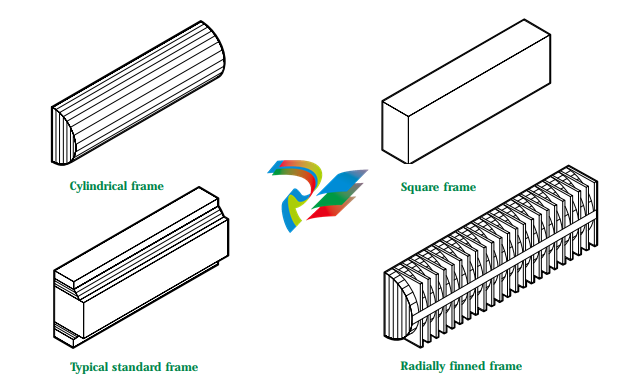
Figure 1. Naturally ventilated motors usually have a relatively smooth
frame surface. The frame is cylindrical or square, or a combination of the
two. The above illustrations show half cross sections of the various motor
types as used in the CFD model
Adding fins to a surface increases the convective cooling –
radiators are an everyday example. Axial fins are common in
forced ventilated motors. CT Dynamics has taken this concept
a stage further to develop the Unimotor range of servo motors.
For a motor to give a performance that requires minimal derating, it must be designed so that it can be mounted in a
number of orientations. The Unimotor’s finned design ensures
that the motors can be mounted horizontally or vertically
without significant effect on heat transfer. CT Dynamics’
engineers derived the optimal fin thickness and spacing using
a specially designed computational fluid dynamics (CFD)
model.
Finned Motors – Designed for Horizontal
and Vertical Orientation
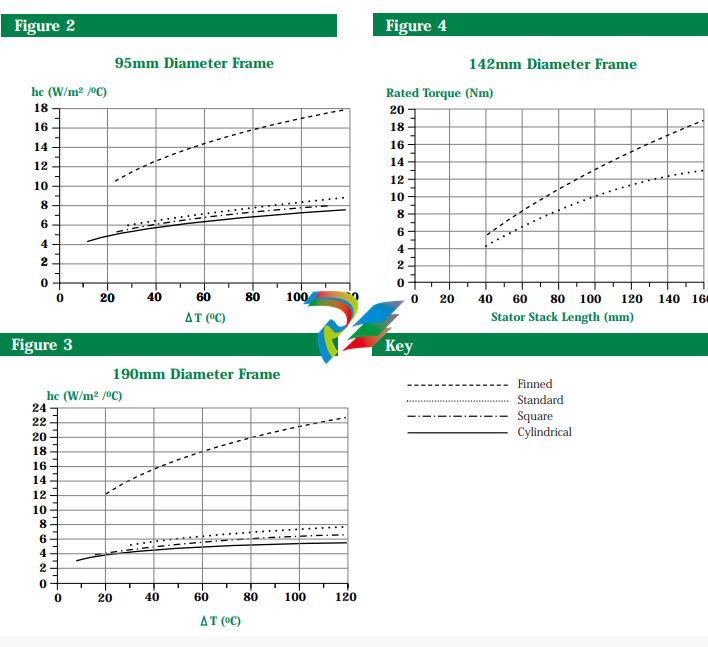
Figures 2 and 3 show charts comparing the variation between
hC (heat transfer coefficient for convection) with ∆T for the
finned motor design against traditional types. The heat
transfer coefficient shows a massive 100% to 200%
improvement over conventional housings.
Figure 4 compares the rated torque of a range of motors with
and without radial finning. The figure takes account of the
effect of any additional conductive cooling through the front
flange and radiation. The additional convection cooling gives
a sizeable increase in torque for the finned motor range.
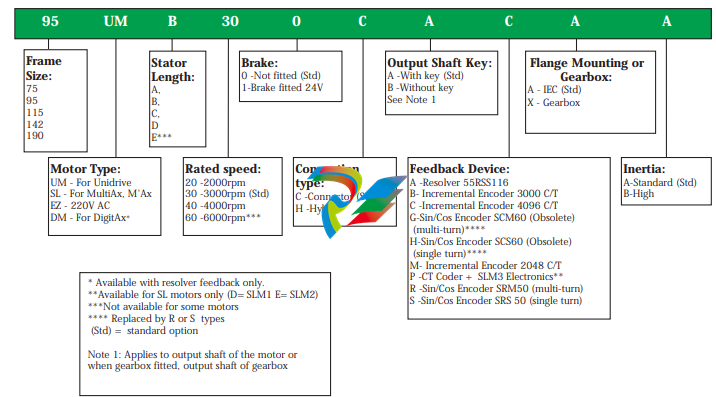
Ordering Information
Use the information given in the illustration below to create
an order code for the Unimotor. The details in the green
band are an example of an order code. CT Dynamics
recommends that you order the required mating connectors
at the time of placing your order. For further details turn to the
cables. See also the grid overleaf, which gives standard and
optional features available for each motor. If you are unsure
which motor you need see ‘Selecting the Correct Motor’.
Leave a comment
Your email address will not be published. Required fields are marked *