Call us 24/7+86 15396210640
Welcome to the official website of Lingkong Automation Technology Co., Ltd!
Call us 24/7+86 15396210640

MTLCertificate Number Baseefa09ATEX0155 Issue 6

ED – TYPE EXAMINATION CERTIFICATE

2 Safety Device, Controlling Device or Regulating Device intended for use outside a potentially explosive atmosphere

but required for or contributing to the safe functioning of Equipment and Protective Systems with respect to the

risks of explosion

Directive 2014/34/EU

3 EU – Type Examination Certificate

Number:

Baseefa09ATEX0155 – Issue 6

3.1 In accordance with Article 41 of Directive 2014/34/EU, EC-Type Examination Certificates referring to 94/9/EC that were in

existence prior to the date of application of2014/34/EU (20 April 2016) may be referenced as if they were issued in accordance

with Directive 2014/34/EU. Supplementary Certificates to such EC-Type Examination Certificates, and new issues of such

certificates, may continue to bear the original certificate number issued prior to 20 April 2016.

4

5

6

Product:

Manufacturer:

Address:

MTL4541S, MTL4541T, MTL4544S & MTL4544D Repeater Power Supplies,

4!20mA

Eaton Electric Limited

Great Marlings, Butterfield, Luton, Bedfordshire, LU2 8DL

7 This re-issued certificate extends EC Type Examination Certificate No. Baseefa09ATEX0155 to apply to product designed and

constructed in accordance with the specification set out in the Schedule ofthe said certificate but having any variations specified

in the Schedule attached to this certificate and the documents therein referred to.

8 SGS Baseefa, Notified Body number 1180, in accordance with Article 17 of Directive 2014/34/EU of the European Parliament

and of the Council, dated 26 February 2014, certifies that this product has been found to comply with the Essential Health and

Safety Requirements relating to the design and construction of products intended for use in potentially explosive atmospheres

given in Annex II to the Directive.

The examination and test results are recorded in confidential Report No. See Certificate History

9 Compliance with the Essential Health and Safety Requirements has been assured by compliance with:

EN 60079-0: 2012 + All: 2013 EN 60079-11: 2012

except in respect ofthose requirements listed at item 18 ofthe Schedule.

10 If the sign “X” is placed after the certificate number, it indicates that the product is subject to the Specific Conditions of Use

specified in the schedule to this certificate.

11 This EU – TYPE EXAMINATION CERTIFICATE relates only to the design and construction of the specified product. Further

requirements of the Directive apply to the manufacturing process and supply of this product. These are not covered by this

certificate.

12 The marking ofthe product shall include the following:

® II (1) GD [Ex ia Gal IIC (-20°C Ta +60 0C)

[Ex ia Da] IIIC (-20°C Ta +60°C)

® I (M1) [Ex ia Ma] I (-20°C Ta +60°C)

SGS Baseefa Customer Reference No. 0703 Project File No. 16/0371

This document is issued by the Company subject to its General Conditions for Certification Services accessible at http://www.sgs.com/enrrerms-andConditions.aspx and the Supplementary Terms and Conditions accessible at http://www.sgs.com/SGSBaseefaiTerms-and-Conditions.aspx Attention is drawn to

the limitation of liability, indemnification and jurisdiction issues defined therein. Any holder of this document is advised that information contained herein

reflects the Company’s findings at the time of its intervention only and within the limits ofClient’s instructions, if any. It does not necessarily indicate that the

equipment may be used in particular industries or circumstances. The Company’s sole responsibility is to its Client and this document does not exonerate

parties to a transaction from exercising all their rights and obligations under the transaction documents. This document cannot be reproduced except in full,

schedule included, without prior written approval of the Company. Any unauthorized alteration, forgery or falsification of the content or appearance of this

document is unlawful and offenders may be prosecuted to the fullest extent ofthe law.

SGS Baseefa Limited

Rockhead Business Park, Staden Lane,

Buxton, Derbyshire SK17 9RZ

Telephone +44 (0) 1298766600 Fax +44 (0) 1298766601

e-mail baseefa@sgs.com web site www.sgs.co.uk/baseefa

Registered in England No. 4305578.

Registered address: Rossmore Business Park, Ellesmere Port, Cheshire, CH65 3EN

R S SINCLAIR

TECHNICAL MANAGER

On behalf of SGS Baseefa Limited

Schedule

Issued 26 September 2016

Page 2 of7

14 Certificate Number Baseefa09ATEX0155 – Issue 6

15 Description of Product

The MTL4544S Two Channel Repeater Power Supply, 4/20mA for ‘Smart’ Transmitters is designed to provide floating

d.c. supplies for energising two ‘Smart’ 4/20mA Transmitters located in the hazardous area and repeat these currents in the

non-hazardous area, whilst restricting the transfer of energy from the unspecified non-hazardous area apparatus to the

intrinsically safe circuits by means of limitation of current and voltage. The apparatus also allows bi-directional signal

communication between the hazardous and non-hazardous area by the connection of a hand-held communicator (HHC).

The MTL4544S Two Channel Repeater Power Supply, 4/20mA for ‘Smart’ Transmitters comprises four isolating

transformers that provide galvanic isolation between the hazardous and non-hazardous area circuitry, zener diode chains

and resistors providing voltage and current limitation. The above, together with other electronic components are mounted

on a single printed circuit board (PCB) and housed in a moulded plastic enclosure. Polarised plugs and sockets are

provided for hazardous and non-hazardous area connections. LED indication is fitted to indicate power-on.

The MTL454IS Single Channel Repeater Power Supply, 4/20mA for ‘Smart’ Transmitters is a depopulated version ofthe

MTL4544S and has only one channel populated.

The MTL4544D Repeater Power Supply, 4/20mA for 2 or 3 Wire Transmitters with two outputs is designed to provide a

floating d.c. supplies for energising a 2 or 3-Wire 4/20mA Transmitter located in the hazardous area and repeat the current

on two channels in the non-hazardous area, whilst restricting the transfer of energy from the unspecified non-hazardous

area apparatus to the intrinsically safe circuits by means of limitation of current and voltage. The apparatus also allows bidirectional signal communication between the hazardous and non-hazardous area by the connection of a hand-held

communicator (HHC). The apparatus uses the same printed circuit board and enclosure as the MTL4544S but is populated

with only one hazardous area transmitter connection and two non-hazardous area outputs fitted.

The MTL454IT Single Channel Repeater Power Supply, 4/20mA for 2 or 3-Wire Transmitters is similar to the

MTL454I S but is fitted with different voltage and current limitation components and therefore has different output

parameters.

MTL4541S, MTL4544S & MTL4544D Input / Output Parameters

Non-hazardous Area Terminals 8, 9, 11, 12, 13 & 14

Urn 253V Lm.S.

The apparatus is designed to operate on non-hazardous area terminals 8, 9, 11, 12, 13 & 14 from a d.c. supply voltage of

up to 35V.

Hazardous Area Terminals 2 W.r.t. 1 (Channel 1)

Or

Hazardous Area Terminals 5 W.r.t. 4 (Channel 2 – MTL4544S model)

28V

93mA

O.65W

o

o

Hazardous Area Terminals 3 W.r.t. 1 (Channel 1)

Or

Hazardous Area Terminals 6 w.r.t. 4 (Channel 2 – MTL4544S model)

1.1V

53mA

15mW

UI

I 1

30V

121mA

C1

L1

o

o

Although the apparatus does not comply with the simple apparatus requirements of Clause 5.7 of EN 60079-11: 2012,

when terminals 3 W.r.t. 1 or terminals 6 W.r.t 4 (MTL4544S model only) are connected in an intrinsically safe circuit the

internal stored energy, voltage and current of the interface will not add more than the values specified in Clause 5.7 of

EN 60079-11: 2012 to the parameters ofthe circuit into which it is connected.

When an external intrinsically safe source is connected to these terminals it should have a source resistance of Uj / Ii and

the capacitance and either the inductance or inductance to resistance ratio (L/R) ofthe hazardous area connections must not

exceed the values detailed in the certificate of the intrinsically safe source. Hazardous area terminals 2 and 5 must not be

used when the source is connected.

Hazardous Area Terminals 2 W.r.t. 3 (Channel 1)

Or

Hazardous Area Terminals 5 W.r.t. 6 (Channel 2 – MTL4544S model)

28V

87mA

0.61W

o

o

Each channel must be considered as a separate intrinsically safe circuit.

Load Parameters

The capacitance and either the inductance or inductance to resistance ratio (L/R) of the hazardous area load connected

must not exceed the following values for either channel:

GROUP CAPACITANCE INDUCTANCE OR LIRRATIO

(J1F) (mH) (J1H/ohm)

Hazardous Area Terminals 2 w.r.t. 1 or 5 W.r.t. 4 (MTL4544S only)

IIC 0.083 4.2 56

IIB* 0.65 12.6 210

IIA 2.15 33.6 444

I 3.76 53.7 668

Hazardous Area Terminals 3 W.r.t. 1 or 6 W.r.t 4 (MTL4544S only)

IIC 100 12.8 2,438

IIB* 1,000 47.8 8,932

IIA 1,000 104.7 18,140

I 1,000 156.2 28,229

Hazardous Area Terminals 2 W.r.t. 3 or 5 W.r.t. 6 (MTL4544S only)

IIC 0.083 4.9 59

lIB* 0.65 20.0 222

IIA 2.15 40.9 469

I 3.76 59.1 710

* Group lIB parameters also applicable for associated apparatus [Ex ia Da] IIIC

Notes:

1) The above load parameters apply when one ofthe two conditions below is given:

– the total Lj ofthe external circuit (excluding the cable) is < 1% ofthe Lovalue or

– the total Ci ofthe external circuit (excluding the cable) is < 1% ofthe Co value.

The above parameters are reduced to 50% when both ofthe two conditions below are given:

– the total Lj ofthe external circuit (excluding the cable) is 1% ofthe Lovalue and

– the total Cj ofthe external circuit (excluding the cable) is 1% ofthe Co value.

The reduced capacitance ofthe external circuit (including cable) shall not be greater than I/-lF for Groups IIB, IIA

& I and 600nF for Group IIC.

MTL4541T Input / Output Parameters

Non-hazardous Area Terminals 8, 9, 11, 13 & 14

Urn 253V r.m.s.

The apparatus is designed to operate on non-hazardous area terminals 8, 9, 11, 13 & 14 from a d.c. supply voltage of up to

35V.

Hazardous Area Terminals 2 W.r.t. 1

22V

167mA

0.92W

o

o

Hazardous Area Terminals 3 W.r.t. 1

1.0V

53mA

14mW

30V

121mA

o

o

Although the apparatus does not comply with the simple apparatus requirements of Clause 5.7 of EN 60079-11: 2012,

when terminals 3 W.r.t. 1 are connected in an intrinsically safe circuit the internal stored energy, voltage and current ofthe

interface will not add more than the values specified in Clause 5.7 of EN 60079-11: 2012 to the parameters of the circuit

into which it is connected.

When an external intrinsically safe source is connected to these terminals it should have a source resistance of Ui / Ii and

the capacitance and either the inductance or inductance to resistance ratio (L/R) ofthe hazardous area connections must not

exceed the values detailed in the certificate of the intrinsically safe source. Hazardous area terminal 2 must not be used

when the source is connected.

Hazardous Area Terminals 2 W.r.t. 3

22V

145mA

0.80W

o

o

Load Parameters

The capacitance and either the inductance or inductance to resistance ratio (L/R) ofthe hazardous area load connected

must not exceed the following values:

GROUP CAPACITANCE INDUCTANCE OR L/RRATIO

(J.lF) (mH) (J.lH/ohm)

Hazardous Area Terminals 2 w.r.t. 1

IIC 0.165 0.91 39

lIB* 1.14 5.5 147

IIA 4.20 10.7 322

I 6.00 16.4 517

* Group IIB parameters also applicable for associated apparatus [Ex ia Da] lIIC

Notes:

1) The above load parameters apply when one ofthe two conditions below is given:

– the total Li ofthe external circuit (excluding the cable) is < 1% ofthe Lo value or

– the total Cj ofthe external circuit (excluding the cable) is < 1% ofthe Co value.

2) The above parameters are reduced to 50% when both ofthe two conditions below are given:

– the total Li ofthe external circuit (excluding the cable) is 1% ofthe Lovalue and

– the total Cj ofthe external circuit (excluding the cable) is 1% ofthe Co value.

The reduced capacitance ofthe external circuit (including cable) shall not be greater than 11lF for Groups IIB, IIA

& I and 600nF for Group IIC.

16 Report Number

GB/BAS/ExTR16.0237/00

17 Specific Conditions of Use

None

18 Essential Health and Safety Requirements

In addition to the Essential Health and Safety Requirements (EHSRs) covered by the standards listed at item 9, the

following are considered relevant to this product, and conformity is demonstrated in the report:

Clause

1.2.7

1.2.8

1.4.1

1.4.2

Subject

Protection against other hazards (LVD type requirements, etc.)

Overloading of equipment (protection relays, etc.)

External effects

Aggressive substances, etc.

Compliance

Manufacturer responsibility

User/Installer responsibility

User/Installer responsibility

User/Installer responsibility

19 Drawings and Documents

New drawings submitted for this issue of certificate:

Number

CI4541-3

Sheet

80f8

Issue

4

Date

7.16

Description

MTL45541S, MTL4541T, MTL4544S, MTL4544D

Certification Label Details – Baseefa

The above drawing is associated and held with IECEx BAS 09.0070 Iss. 6

Current drawings which remain unaffected by this issue:

Certificate No.

Baseefa09ATEX0155/2

Baseefa09ATEXO155/3

Baseefa09ATEX0155/4

Baseefa09ATEXO 155/5

Date

31 January 2011

6 August 2012

4 March 2013

27 January 2014

Comments

i) To permit the alternative fitting of ISMB3EZ** zener diodes in

place of 15MB59**BT3 components currently fitted.

ii) An alternative method of applying the conformal coating to the

PCB fitted 10 the equipment not affecting the original

assessment.

The associated test and assessment is documented in Certification

Report No. GB/BAS/ExTR10.0298/00.

To confirm the current designs of the MTL4541S, MTL4544S &

MTL4544D Repeater Power Supplies, 4/20mA have been reviewed

against the requirements of IEC 60079-0: 2011 and

EN 60079-11: 2012 10 respect of the differences from

EN 60079-0: 2009, EN 60079-11: 2007 and EN 61241-11: 2006 and

none ofthe differences affect the equipment. In accordance with EN

60079-11: 2012, the Group I capacitive load parameters were

corrected and the associated load parameter notes were updated.

The associated assessment is documented in Certification Report

No. GB/BAS/ExTR12.0181/00.

i) To permit minor component changes to the current design to

form the MTL4541T Single Channel Repeater Power Supply,

4/20mA for 2 or 3-Wire Transmitters.

ii) To confirm the current designs ofthe MTL4541S, MTL4541T,

MTL4544S & MTL4544D Repeater Power Supplies, 4/20mA

have been reviewed against the requirements of EN 60079-0:

2012 in respect ofthe differences from IEC 60079-0: 2011 and

none ofthe differences affect the equipment.

The associated assessment is documented in Certification Report

No. GB/BAS/ExTR13.0022/00.

i) To permit minor component changes to the MTL4541 T Single

Channel Repeater Power Supply, 4/20mA for 2 or 3-Wire

Transmitters not affect the original assessment.

ii) To permit minor drawing changes not affecting the original

assessment.

The associated assessment is documented in Certification Report

No. GB/BAS/ExTR14.0019/00.

Baseefa09ATEXO 155 Issue 6 26

2016

September This issue of the certificate incorporates previously issued primary

& supplementary certificates into one certificate and confirms the

current designs meet the requirements of

EN 60079-0: 2012 + All: 2013 & EN 60079-11: 2012.

The certificate also permits the manufacturer’s name to be changed

on page 1 ofthe certificate and on the equipment marking.

The associated assessment is documented in Certification Report

No. GB/BAS/ExTR16.0237/00.

For drawings applicable to each issue, see original ofthat issue
MTLCertificate Number Baseefa09ATEX0155 Issue 6

ED – TYPE EXAMINATION CERTIFICATE

2 Safety Device, Controlling Device or Regulating Device intended for use outside a potentially explosive atmosphere

but required for or contributing to the safe functioning of Equipment and Protective Systems with respect to the

risks of explosion

Directive 2014/34/EU

3 EU – Type Examination Certificate

Number:

Baseefa09ATEX0155 – Issue 6

3.1 In accordance with Article 41 of Directive 2014/34/EU, EC-Type Examination Certificates referring to 94/9/EC that were in

existence prior to the date of application of2014/34/EU (20 April 2016) may be referenced as if they were issued in accordance

with Directive 2014/34/EU. Supplementary Certificates to such EC-Type Examination Certificates, and new issues of such

certificates, may continue to bear the original certificate number issued prior to 20 April 2016.

4

5

6

Product:

Manufacturer:

Address:

MTL4541S, MTL4541T, MTL4544S & MTL4544D Repeater Power Supplies,

4!20mA

Eaton Electric Limited

Great Marlings, Butterfield, Luton, Bedfordshire, LU2 8DL

7 This re-issued certificate extends EC Type Examination Certificate No. Baseefa09ATEX0155 to apply to product designed and

constructed in accordance with the specification set out in the Schedule ofthe said certificate but having any variations specified

in the Schedule attached to this certificate and the documents therein referred to.

8 SGS Baseefa, Notified Body number 1180, in accordance with Article 17 of Directive 2014/34/EU of the European Parliament

and of the Council, dated 26 February 2014, certifies that this product has been found to comply with the Essential Health and

Safety Requirements relating to the design and construction of products intended for use in potentially explosive atmospheres

given in Annex II to the Directive.

The examination and test results are recorded in confidential Report No. See Certificate History

9 Compliance with the Essential Health and Safety Requirements has been assured by compliance with:

EN 60079-0: 2012 + All: 2013 EN 60079-11: 2012

except in respect ofthose requirements listed at item 18 ofthe Schedule.

10 If the sign “X” is placed after the certificate number, it indicates that the product is subject to the Specific Conditions of Use

specified in the schedule to this certificate.

11 This EU – TYPE EXAMINATION CERTIFICATE relates only to the design and construction of the specified product. Further

requirements of the Directive apply to the manufacturing process and supply of this product. These are not covered by this

certificate.

12 The marking ofthe product shall include the following:

® II (1) GD [Ex ia Gal IIC (-20°C Ta +60 0C)

[Ex ia Da] IIIC (-20°C Ta +60°C)

® I (M1) [Ex ia Ma] I (-20°C Ta +60°C)

SGS Baseefa Customer Reference No. 0703 Project File No. 16/0371

This document is issued by the Company subject to its General Conditions for Certification Services accessible at http://www.sgs.com/enrrerms-andConditions.aspx and the Supplementary Terms and Conditions accessible at http://www.sgs.com/SGSBaseefaiTerms-and-Conditions.aspx Attention is drawn to

the limitation of liability, indemnification and jurisdiction issues defined therein. Any holder of this document is advised that information contained herein

reflects the Company’s findings at the time of its intervention only and within the limits ofClient’s instructions, if any. It does not necessarily indicate that the

equipment may be used in particular industries or circumstances. The Company’s sole responsibility is to its Client and this document does not exonerate

parties to a transaction from exercising all their rights and obligations under the transaction documents. This document cannot be reproduced except in full,

schedule included, without prior written approval of the Company. Any unauthorized alteration, forgery or falsification of the content or appearance of this

document is unlawful and offenders may be prosecuted to the fullest extent ofthe law.

SGS Baseefa Limited

Rockhead Business Park, Staden Lane,

Buxton, Derbyshire SK17 9RZ

Telephone +44 (0) 1298766600 Fax +44 (0) 1298766601

e-mail baseefa@sgs.com web site www.sgs.co.uk/baseefa

Registered in England No. 4305578.

Registered address: Rossmore Business Park, Ellesmere Port, Cheshire, CH65 3EN

R S SINCLAIR

TECHNICAL MANAGER

On behalf of SGS Baseefa Limited

Schedule

Issued 26 September 2016

Page 2 of7

14 Certificate Number Baseefa09ATEX0155 – Issue 6

15 Description of Product

The MTL4544S Two Channel Repeater Power Supply, 4/20mA for ‘Smart’ Transmitters is designed to provide floating

d.c. supplies for energising two ‘Smart’ 4/20mA Transmitters located in the hazardous area and repeat these currents in the

non-hazardous area, whilst restricting the transfer of energy from the unspecified non-hazardous area apparatus to the

intrinsically safe circuits by means of limitation of current and voltage. The apparatus also allows bi-directional signal

communication between the hazardous and non-hazardous area by the connection of a hand-held communicator (HHC).

The MTL4544S Two Channel Repeater Power Supply, 4/20mA for ‘Smart’ Transmitters comprises four isolating

transformers that provide galvanic isolation between the hazardous and non-hazardous area circuitry, zener diode chains

and resistors providing voltage and current limitation. The above, together with other electronic components are mounted

on a single printed circuit board (PCB) and housed in a moulded plastic enclosure. Polarised plugs and sockets are

provided for hazardous and non-hazardous area connections. LED indication is fitted to indicate power-on.

The MTL454IS Single Channel Repeater Power Supply, 4/20mA for ‘Smart’ Transmitters is a depopulated version ofthe

MTL4544S and has only one channel populated.

The MTL4544D Repeater Power Supply, 4/20mA for 2 or 3 Wire Transmitters with two outputs is designed to provide a

floating d.c. supplies for energising a 2 or 3-Wire 4/20mA Transmitter located in the hazardous area and repeat the current

on two channels in the non-hazardous area, whilst restricting the transfer of energy from the unspecified non-hazardous

area apparatus to the intrinsically safe circuits by means of limitation of current and voltage. The apparatus also allows bidirectional signal communication between the hazardous and non-hazardous area by the connection of a hand-held

communicator (HHC). The apparatus uses the same printed circuit board and enclosure as the MTL4544S but is populated

with only one hazardous area transmitter connection and two non-hazardous area outputs fitted.

The MTL454IT Single Channel Repeater Power Supply, 4/20mA for 2 or 3-Wire Transmitters is similar to the

MTL454I S but is fitted with different voltage and current limitation components and therefore has different output

parameters.

MTL4541S, MTL4544S & MTL4544D Input / Output Parameters

Non-hazardous Area Terminals 8, 9, 11, 12, 13 & 14

Urn 253V Lm.S.

The apparatus is designed to operate on non-hazardous area terminals 8, 9, 11, 12, 13 & 14 from a d.c. supply voltage of

up to 35V.

Hazardous Area Terminals 2 W.r.t. 1 (Channel 1)

Or

Hazardous Area Terminals 5 W.r.t. 4 (Channel 2 – MTL4544S model)

28V

93mA

O.65W

o

o

Hazardous Area Terminals 3 W.r.t. 1 (Channel 1)

Or

Hazardous Area Terminals 6 w.r.t. 4 (Channel 2 – MTL4544S model)

1.1V

53mA

15mW

UI

I 1

30V

121mA

C1

L1

o

o

Although the apparatus does not comply with the simple apparatus requirements of Clause 5.7 of EN 60079-11: 2012,

when terminals 3 W.r.t. 1 or terminals 6 W.r.t 4 (MTL4544S model only) are connected in an intrinsically safe circuit the

internal stored energy, voltage and current of the interface will not add more than the values specified in Clause 5.7 of

EN 60079-11: 2012 to the parameters ofthe circuit into which it is connected.

When an external intrinsically safe source is connected to these terminals it should have a source resistance of Uj / Ii and

the capacitance and either the inductance or inductance to resistance ratio (L/R) ofthe hazardous area connections must not

exceed the values detailed in the certificate of the intrinsically safe source. Hazardous area terminals 2 and 5 must not be

used when the source is connected.

Hazardous Area Terminals 2 W.r.t. 3 (Channel 1)

Or

Hazardous Area Terminals 5 W.r.t. 6 (Channel 2 – MTL4544S model)

28V

87mA

0.61W

o

o

Each channel must be considered as a separate intrinsically safe circuit.

Load Parameters

The capacitance and either the inductance or inductance to resistance ratio (L/R) of the hazardous area load connected

must not exceed the following values for either channel:

GROUP CAPACITANCE INDUCTANCE OR LIRRATIO

(J1F) (mH) (J1H/ohm)

Hazardous Area Terminals 2 w.r.t. 1 or 5 W.r.t. 4 (MTL4544S only)

IIC 0.083 4.2 56

IIB* 0.65 12.6 210

IIA 2.15 33.6 444

I 3.76 53.7 668

Hazardous Area Terminals 3 W.r.t. 1 or 6 W.r.t 4 (MTL4544S only)

IIC 100 12.8 2,438

IIB* 1,000 47.8 8,932

IIA 1,000 104.7 18,140

I 1,000 156.2 28,229

Hazardous Area Terminals 2 W.r.t. 3 or 5 W.r.t. 6 (MTL4544S only)

IIC 0.083 4.9 59

lIB* 0.65 20.0 222

IIA 2.15 40.9 469

I 3.76 59.1 710

* Group lIB parameters also applicable for associated apparatus [Ex ia Da] IIIC

Notes:

1) The above load parameters apply when one ofthe two conditions below is given:

– the total Lj ofthe external circuit (excluding the cable) is < 1% ofthe Lovalue or

– the total Ci ofthe external circuit (excluding the cable) is < 1% ofthe Co value.

The above parameters are reduced to 50% when both ofthe two conditions below are given:

– the total Lj ofthe external circuit (excluding the cable) is 1% ofthe Lovalue and

– the total Cj ofthe external circuit (excluding the cable) is 1% ofthe Co value.

The reduced capacitance ofthe external circuit (including cable) shall not be greater than I/-lF for Groups IIB, IIA

& I and 600nF for Group IIC.

MTL4541T Input / Output Parameters

Non-hazardous Area Terminals 8, 9, 11, 13 & 14

Urn 253V r.m.s.

The apparatus is designed to operate on non-hazardous area terminals 8, 9, 11, 13 & 14 from a d.c. supply voltage of up to

35V.

Hazardous Area Terminals 2 W.r.t. 1

22V

167mA

0.92W

o

o

Hazardous Area Terminals 3 W.r.t. 1

1.0V

53mA

14mW

30V

121mA

o

o

Although the apparatus does not comply with the simple apparatus requirements of Clause 5.7 of EN 60079-11: 2012,

when terminals 3 W.r.t. 1 are connected in an intrinsically safe circuit the internal stored energy, voltage and current ofthe

interface will not add more than the values specified in Clause 5.7 of EN 60079-11: 2012 to the parameters of the circuit

into which it is connected.

When an external intrinsically safe source is connected to these terminals it should have a source resistance of Ui / Ii and

the capacitance and either the inductance or inductance to resistance ratio (L/R) ofthe hazardous area connections must not

exceed the values detailed in the certificate of the intrinsically safe source. Hazardous area terminal 2 must not be used

when the source is connected.

Hazardous Area Terminals 2 W.r.t. 3

22V

145mA

0.80W

o

o

Load Parameters

The capacitance and either the inductance or inductance to resistance ratio (L/R) ofthe hazardous area load connected

must not exceed the following values:

GROUP CAPACITANCE INDUCTANCE OR L/RRATIO

(J.lF) (mH) (J.lH/ohm)

Hazardous Area Terminals 2 w.r.t. 1

IIC 0.165 0.91 39

lIB* 1.14 5.5 147

IIA 4.20 10.7 322

I 6.00 16.4 517

* Group IIB parameters also applicable for associated apparatus [Ex ia Da] lIIC

Notes:

1) The above load parameters apply when one ofthe two conditions below is given:

– the total Li ofthe external circuit (excluding the cable) is < 1% ofthe Lo value or

– the total Cj ofthe external circuit (excluding the cable) is < 1% ofthe Co value.

2) The above parameters are reduced to 50% when both ofthe two conditions below are given:

– the total Li ofthe external circuit (excluding the cable) is 1% ofthe Lovalue and

– the total Cj ofthe external circuit (excluding the cable) is 1% ofthe Co value.

The reduced capacitance ofthe external circuit (including cable) shall not be greater than 11lF for Groups IIB, IIA

& I and 600nF for Group IIC.

16 Report Number

GB/BAS/ExTR16.0237/00

17 Specific Conditions of Use

None

18 Essential Health and Safety Requirements

In addition to the Essential Health and Safety Requirements (EHSRs) covered by the standards listed at item 9, the

following are considered relevant to this product, and conformity is demonstrated in the report:

Clause

1.2.7

1.2.8

1.4.1

1.4.2

Subject

Protection against other hazards (LVD type requirements, etc.)

Overloading of equipment (protection relays, etc.)

External effects

Aggressive substances, etc.

Compliance

Manufacturer responsibility

User/Installer responsibility

User/Installer responsibility

User/Installer responsibility

19 Drawings and Documents

New drawings submitted for this issue of certificate:

Number

CI4541-3

Sheet

80f8

Issue

4

Date

7.16

Description

MTL45541S, MTL4541T, MTL4544S, MTL4544D

Certification Label Details – Baseefa

The above drawing is associated and held with IECEx BAS 09.0070 Iss. 6

Current drawings which remain unaffected by this issue:

Certificate No.

Baseefa09ATEX0155/2

Baseefa09ATEXO155/3

Baseefa09ATEX0155/4

Baseefa09ATEXO 155/5

Date

31 January 2011

6 August 2012

4 March 2013

27 January 2014

Comments

i) To permit the alternative fitting of ISMB3EZ** zener diodes in

place of 15MB59**BT3 components currently fitted.

ii) An alternative method of applying the conformal coating to the

PCB fitted 10 the equipment not affecting the original

assessment.

The associated test and assessment is documented in Certification

Report No. GB/BAS/ExTR10.0298/00.

To confirm the current designs of the MTL4541S, MTL4544S &

MTL4544D Repeater Power Supplies, 4/20mA have been reviewed

against the requirements of IEC 60079-0: 2011 and

EN 60079-11: 2012 10 respect of the differences from

EN 60079-0: 2009, EN 60079-11: 2007 and EN 61241-11: 2006 and

none ofthe differences affect the equipment. In accordance with EN

60079-11: 2012, the Group I capacitive load parameters were

corrected and the associated load parameter notes were updated.

The associated assessment is documented in Certification Report

No. GB/BAS/ExTR12.0181/00.

i) To permit minor component changes to the current design to

form the MTL4541T Single Channel Repeater Power Supply,

4/20mA for 2 or 3-Wire Transmitters.

ii) To confirm the current designs ofthe MTL4541S, MTL4541T,

MTL4544S & MTL4544D Repeater Power Supplies, 4/20mA

have been reviewed against the requirements of EN 60079-0:

2012 in respect ofthe differences from IEC 60079-0: 2011 and

none ofthe differences affect the equipment.

The associated assessment is documented in Certification Report

No. GB/BAS/ExTR13.0022/00.

i) To permit minor component changes to the MTL4541 T Single

Channel Repeater Power Supply, 4/20mA for 2 or 3-Wire

Transmitters not affect the original assessment.

ii) To permit minor drawing changes not affecting the original

assessment.

The associated assessment is documented in Certification Report

No. GB/BAS/ExTR14.0019/00.

Baseefa09ATEXO 155 Issue 6 26

2016

September This issue of the certificate incorporates previously issued primary

& supplementary certificates into one certificate and confirms the

current designs meet the requirements of

EN 60079-0: 2012 + All: 2013 & EN 60079-11: 2012.

The certificate also permits the manufacturer’s name to be changed

on page 1 ofthe certificate and on the equipment marking.

The associated assessment is documented in Certification Report

No. GB/BAS/ExTR16.0237/00.

For drawings applicable to each issue, see original ofthat issue
NIOPERATING INSTRUCTIONS AND SPECIFICATIONS NI 9505

This document describes how to use the National Instruments 9505 

module and includes specifications and pin assignments for the 

NI 9505.

Note The safety guidelines and specifications in this 

document are specific to the NI 9505. The other 

components in the system may not meet the same safety 

ratings and specifications. Refer to the documentation for 

each component in the system to determine the safety 

ratings and specifications for the entire system.

Caution This product may cause radio interference in 

a domestic environment, in which case supplementary 

mitigation measures may be required.

Related Information

Safety Guidelines

Operate the NI 9505 only as described in these operating 

instructions.

Safety Guidelines for Hazardous Locations

The NI 9505 is suitable for use in Class I, Division 2, Groups A, B, 

C, D, T4 hazardous locations; Class I, Zone 2, AEx nA IIC T4 and 

Ex nA IIC T4 hazardous locations; and nonhazardous locations 

only. Follow these guidelines if you are installing the NI 9505 in a 

potentially explosive environment. Not following these guidelines 

may result in serious injury or death.

Caution Do not disconnect I/O-side wires or connectors 

unless power has been switched off or the area is known to 

be nonhazardous.

Caution Do not remove modules unless power has been 

switched off or the area is known to be nonhazardous.

Caution Substitution of components may impair 

suitability for Class I, Division 2.

Caution For Division 2 and Zone 2 applications, install 

the system in an enclosure rated to at least IP 54 as defined 

by IEC/EN 60079-15.

Caution For Division 2 and Zone 2 applications, install a 

protection device between the input signal and the Vsup 

pin. The device must prevent the Vsup-to-channel voltage 

from exceeding 42 V if there is a transient overvoltage 

condition.

Special Conditions for Hazardous Locations Use in 

Europe and Internationally

This equipment has been evaluated as Ex nA IIC T4 Gc equipment 

under DEMKO Certificate No. 07 ATEX 0626664X and is IECEx 

UL 14.0089X certified. Each module is marked II 3G and is 

suitable for use in Zone 2 hazardous locations, in ambient 

temperatures of -40 °C  Ta  70 °C. If you are using the NI 9505 

in Gas Group IIC hazardous locations, you must use the device in 

an NI chassis that has been evaluated as Ex nC IIC T4, Ex IIC T4, 

Ex nA IIC T4, or Ex nL IIC T4 equipment.

Caution You must make sure that transient disturbances 

do not exceed 140% of the rated voltage

Caution The system shall only be used in an area of not 

more than Pollution Degree 2, as defined in IEC 60664-1.

Caution The system shall be mounted in an 

ATEX/IECEx-certified enclosure with a minimum ingress 

protection rating of at least IP54 as defined in 

IEC/EN 60079-15.

Caution The enclosure must have a door or cover 

accessible only by the use of a tool.

Electromagnetic Compatibility Guidelines

This product was tested and complies with the regulatory 

requirements and limits for electromagnetic compatibility (EMC) 

as stated in the product specifications. These requirements and 

limits are designed to provide reasonable protection against 

harmful interference when the product is operated in its intended 

operational electromagnetic environment.

This product is intended for use in industrial locations. As such, 

there is no guarantee that harmful interference will not occur in 

a particular installation, when the product is connected to a test 

object, or if the product is used in residential areas. To minimize

the potential for the product to cause interference to radio and 

television reception or to experience unacceptable performance 

degradation, install and use this product in strict accordance with 

the instructions in the product documentation.

Furthermore, any changes or modifications to the product not 

expressly approved by National Instruments could void your 

authority to operate it under your local regulatory rules.

Caution To ensure compliance with the applicable 

regulatory requirements, product installation requires 

either special considerations or user-installed, add-on 

devices. See the product installation instructions for 

further information.

Caution The inputs/outputs of this product can be 

damaged if subjected to Electrostatic Discharge (ESD). To 

prevent damage, industry-standard ESD prevention 

measures must be employed during installation, 

maintenance, and operation.

Special Conditions for Marine Applications

Some modules are Lloyd’s Register (LR) Type Approved for 

marine applications. To verify Lloyd’s Register certification, go 

to ni.com/certification and search for the LR certificate, or 

look for the Lloyd’s Register mark on the module.

Caution To meet radio frequency emission requirements 

for marine applications, use shielded cables and install the 

system in a metal enclosure. Suppression ferrites must be 

installed on power supply inputs near power entries to 

modules and controllers. Power supply and module cables 

must be separated on opposite sides of the enclosure and 

must enter and exit through opposing enclosure walls.

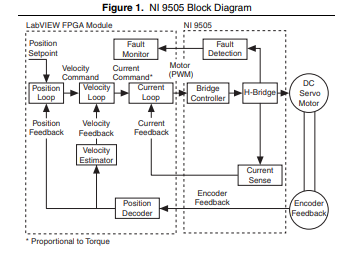
NI 9505 Hardware Overview

The NI 9505 provides unique flexibility and customization. The 
NI 9505 works together with the LabVIEW FPGA Module to 

create a highly customizable motor drive or actuator amplifier. 

Figure 1 illustrates the functionality of the NI 9505 working in 

conjunction with the LabVIEW FPGA Module in a typical motion 

control application. Figures 2 and 3 show more detailed versions 

of the position, velocity, and current loops implemented in the

LabVIEW FPGA Module. A typical application contains a 

position loop, velocity loop, and current loop, implemented in 

the LabVIEW FPGA Module block diagram. Depending on the 

application, you may not need to use all three loops. The examples 

installed in the labviewexamplesCompactRIOModule

SpecificNI 9505 directory illustrate methods for implementing 

each of these loops.

The NI 9505 returns the motor or actuator current data to the 

LabVIEW FPGA Module for use in a current loop or for 

monitoring. The NI 9505 also returns status information such as 

drive fault status, VSUP presence, and emergency stop status to the 

LabVIEW FPGA Module for use in system monitoring. Refer 

to the NI 9505 Reference Help book in the LabVIEW Help, 

available by selecting Help»Search the LabVIEW Help, for 

more information about the available status information.

The LabVIEW FPGA Module generates a PWM signal and sends 

the signal to the NI 9505. The PWM signal is proportional to the 

desired current or torque you want to provide to the motor or 

actuator. Increasing the PWM duty cycle results in increased 

current and thus increased torque. 

Quadrature encoder signals pass through the NI 9505 and are 

processed in the LabVIEW FPGA Module for use in the position 

Hot-Swap Behavior

The NI 9505 is always disabled when it is inserted in the chassis, 

regardless of whether VSUP is present or not. You can enable the 

drive using the Enable Drive method in software. Refer to the 

NI 9505 Reference Help book in the LabVIEW Help, available 

by selecting Help»Search the LabVIEW Help, for more 

information about enabling the drive.

When the NI 9505 is removed from the chassis while it is enabled, 

the power to the motor is removed and the motor decelerates to a 

stop based on its own friction.

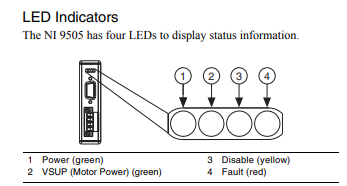
Power

The Power LED (green) illuminates when the NI 9505 is properly 

inserted into a powered chassis.

Note The Power LED does not illuminate when the 

chassis is in sleep mode. 

VSUP

The VSUP LED (green) illuminates when the motor DC power 

supply is properly connected and powering the drive.

Disable

The Disable LED (yellow) illuminates when the drive is disabled. 

The drive is disabled by default at power-on. You can enable the 

drive using the Enable Drive method in software. Refer to the 

NI 9505 Reference Help book in the LabVIEW Help, available 

by selecting Help»Search the LabVIEW Help, for more 

information about this method.

Fault

Caution If the Fault LED is lit, determine the cause of the 

fault and correct it before enabling the drive.

The Fault LED (red) illuminates when a fault occurs. A fault 

disables the drive. Causes for fault are the following:

Caution VSUP greater than 40 V will result in damage to 

the NI 9505.

• Overvoltage

• Undervoltage

• Motor terminal (MOTOR±) short to VSUP

• Motor terminal (MOTOR±) short to COM

• Module temperature exceeds 115 ºC

• Sending commands to the motor before enabling the drive

Note Do not command motor movement until the drive is 

enabled with the Enable Drive method. Attempting to 

control the motor before it is enabled will result in a fault.

• Violating PWM minimum pulse width requirements. Refer to 

the Specifications section for more information about PWM.

Sleep Mode

This module supports a low-power sleep mode. Support for sleep 

mode at the system level depends on the chassis that the module is 

plugged into. Refer to the chassis manual for information about 

support for sleep mode. If the chassis supports sleep mode, refer 

to the software help for information about enabling sleep mode. 

Visit ni.com/info and enter cseriesdoc for information about 

C Series documentation.

Typically, when a system is in sleep mode, you cannot 

communicate with the modules. In sleep mode, the system 

consumes minimal power and may dissipate less heat than it does 

in normal mode. Refer to the Specifications section for more 

information about power consumption and thermal dissipation.

Wiring the NI 9505

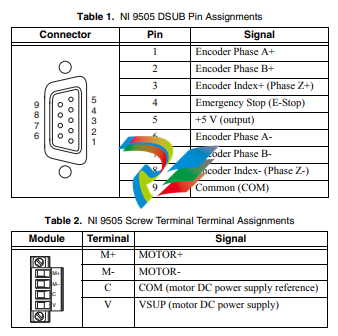
The NI 9505 has a 9-pin female DSUB connector that provides 

connections for the encoder inputs, a +5 V connection for encoder 

power, a connection for an emergency stop input, and a connection 

to COM. Refer to Table 1 for the pin assignments.

The NI 9505 also has a screw terminal connector that provides 

connections to a motor DC power supply and a DC brushed servo 

motor. Connect the positive lead of the power supply to terminal 4, 

VSUP, and the negative lead to terminal 3, COM. Refer to Table 2 

for the terminal assignments.

Note You must use 2-wire ferrules to create a secure 

connection when connecting more than one wire to a 

single terminal on the NI 9505 screw terminal.

Caution Do not turn on or plug in the motor DC power 

supply until the screw terminal connector is fully inserted.

Optional Screw Terminal Accessory

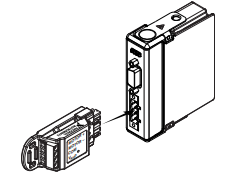
Use the NI 9931 Screw Terminal Accessory instead of the 

detachable screw terminal connector to increase the output power 

of the module at temperatures below 70 ºC. The NI 9931 is 

available from ni.com (NI part number 780571-01) or by calling 

your National Instruments sales representative. Refer to the 

Specifications section for more information. Refer to Figure 5 for 

an illustration.

Figure 5. NI 9505 Module with Optional Screw Terminal Accessory

Wiring for High Vibration Applications

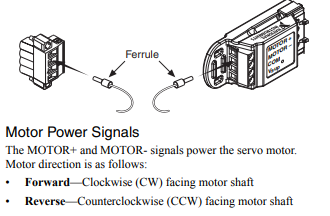
National Instruments recommends using ferrules to terminate 

wires to the detachable screw terminal connector or the NI 9931 

Screw Terminal Accessory when you use the NI 9505 in high 

vibration applications. Refer to Figure 6 for an illustration.

Figure 6. 4-Terminal Screw Terminal Connector or 

Accessory with a Ferrule

Motor Power Signals

The MOTOR+ and MOTOR- signals power the servo motor. 

Motor direction is as follows:

• Forward—Clockwise (CW) facing motor shaft

• Reverse—Counterclockwise (CCW) facing motor shaf

Encoder Signals

The encoder signals consist of a Phase A, Phase B, and Index 

(Phase Z) input. The NI 9505 supports differential and 

single-ended inputs for Phase A, Phase B, and Index (Phase Z) 

signals. Figures 8 and 9 show simplified schematic diagrams of the 

encoder input circuit connected to differential and single-ended 

inputs. You can also accommodate open-collector output encoders

by using a 1 kΩ pull-up resistor on each line to +5 VDC. Refer to 

the Specifications section for more information about the encoder 

inputs. 

The encoder signals are raw digital input signals. These signals are 

used in the LabVIEW FPGA Module for position and/or velocity 

feedback. Figures 8 and 9 illustrate the use of the encoder signals 

in a position and velocity loop in the LabVIEW FPGA Module. 

Refer to the examples installed at labviewexamples

CompactRIOModule SpecificNI 9505 for examples of using 

the encoder signals. Refer to the NI 9505 Reference Help book 

in the LabVIEW Help, available by selecting Help»Search the 

LabVIEW Help, for more information. 

If the encoder cable length is greater than 3.05 m (10 ft), use 

encoders with differential line driver outputs for your applications. 

Power for a +5 V encoder—generated by a power supply inside the 

NI 9505—is available on pin 5 of the DSUB connector.

Note The internal power supply is powered through the 

Vsup pin. 

Closed-loop servo applications require consistent directional 

polarity between the motor and encoder for correct operation. 

One industry-standard directional polarity is as follows:

• Positive = forward = clockwise (CW) facing motor shaft

• Negative = reverse = counterclockwise (CCW) facing motor 

shaft

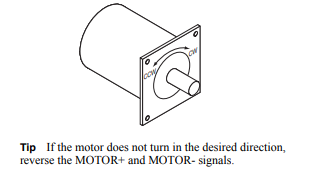
Refer to Figure 7 for a depiction of clockwise and 

counterclockwise rotation. If encoder counting does not behave as 

expected, change the encoder polarity in the FPGA or swap the 

Phase A and Phase B connections.

When connecting the encoder wiring to the NI 9505, use shielded 

wire of at least 24 AWG. You must use cables with twisted pairs 

and an overall shield for improved noise immunity. Refer to 

Figure 4 for a connection example.

Note Using an unshielded cable may produce noise, 

which can corrupt the encoder signals and cause lost 

counts, reduced accuracy, or other erroneous encoder and 

drive operation.

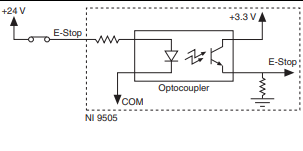
Emergency Stop Signal

The E-Stop signal is an input to the drive from an emergency stop 

switch. Figure 10 shows a simplified schematic of the emergency 

stop input circuit. When the emergency stop switch is closed, 

current flows through the circuit, and the drive is enabled. When 

an external event activates the emergency stop switch, the switch 

opens and current stops flowing, disabling the drive. The E-Stop 

functionality is disabled by default. Refer to the NI 9505 Reference 

Help book in the LabVIEW Help, available by selecting Help»

Search the LabVIEW Help, for information about how to enable 

this signal using the Enable E-Stop Property.

Figure 10. Emergency Stop Input Circuit

Cable Requirements for EMC Compliance

Use the following guidelines when selecting cables for the 

NI 9505:

• Use shielded cables with a low impedance connection to 

chassis ground to minimize noise and signal crosstalk.

• Tie the VSUP cable shield to chassis ground at the module side 

only.

• Tie the motor cable shield to chassis ground at the motor side 

only.

• Tie the encoder cable shield to COM at the encoder side only.

• Wire encoder signals and their ground connections separately 

from all other connections to prevent lost encoder counts.

• Route wires along the machine frame to reduce high frequency 

noise.

• Add clamp-on ferrites to cables to further reduce emissions.

• Add a balun to the power cable to attenuate conducted and 

radiated emissions

Channel-to-COM …………………………0 to +30 VDC max, 

Measurement Category I

Isolation

Channel-to-channel ………………..None

Channel-to-earth ground

Continuous ………………………60 VDC, 

Measurement Category I

Withstand ………………………..750 Vrms, verified by a 5 s

dielectric withstand test

Measurement Category I is for measurements performed on 

circuits not directly connected to the electrical distribution system 

referred to as MAINS voltage. MAINS is a hazardous live electrical 

supply system that powers equipment. This category is for 

measurements of voltages from specially protected secondary 

circuits. Such voltage measurements include signal levels, special 

equipment, limited-energy parts of equipment, circuits powered by 

regulated low-voltage sources, and electronics.

Caution Do not connect the NI 9505 to signals or use for 

measurements within Measurement Categories II, III, or IV.

CE Compliance

This product meets the essential requirements of applicable 

European directives as follows:

• 2014/35/EU; Low-Voltage Directive (safety)

• 2014/30/EU; Electromagnetic Compatibility Directive (EMC)

• 94/9/EC; Potentially Explosive Atmospheres (ATEX)

Online Product Certification

Refer to the product Declaration of Conformity (DoC) for 

additional regulatory compliance information. To obtain product 

certifications and the DoC for this product, visit ni.com/

certification, search by module number or product line, and 

click the appropriate link in the Certification column.

Shock and Vibration

To meet these specifications, you must panel mount the system and 

affix ferrules to the end of the screw terminal wires.

Operating vibration

Random (IEC 60068-2-64)………5 grms, 10 to 500 Hz

Sinusoidal (IEC 60068-2-6) …….5 g, 10 to 500 Hz

Environmental Management

NI is committed to designing and manufacturing products in an 

environmentally responsible manner. NI recognizes that 

eliminating certain hazardous substances from our products is 

beneficial to the environment and to NI customers.

For additional environmental information, refer to the Minimize 

Our Environmental Impact web page at ni.com/environment. 

This page contains the environmental regulations and directives 

with which NI complies, as well as other environmental 

information not included in this document.

Waste Electrical and Electronic Equipment (WEEE)

EU Customers At the end of the product life cycle, 

all products must be sent to a WEEE recycling center. 

For more information about WEEE recycling centers, 

National Instruments WEEE initiatives, and compliance 

with WEEE Directive 2002/96/EC on Waste and Electronic 

Equipment, visit ni.com/environment/weee.

Worldwide Support and Services

The NI website is your complete resource for technical support. At 

ni.com/support you have access to everything from 

troubleshooting and application development self-help resources 

to email and phone assistance from NI Application Engineers.

Visit ni.com/services for NI Factory Installation Services, 

repairs, extended warranty, and other services.

Visit ni.com/register to register your NI product. Product 

registration facilitates technical support and ensures that you 

receive important information updates from NI.

A Declaration of Conformity (DoC) is our claim of compliance 

with the Council of the European Communities using the 

manufacturer’s declaration of conformity. This system affords the 

⬉ᄤֵᙃѻક∵ᶧ᥻ࠊㅵ⧚ࡲ˄ ⫣Ё೑ RoHS˅

Ё೑ᅶ᠋ National Instruments ヺড়Ё೑⬉ᄤֵᙃ

ѻકЁ䰤ࠊՓ⫼ᶤѯ᳝ᆇ⠽䋼ᣛҸ (RoHS)DŽ݇Ѣ

National Instruments Ё೑ RoHS ড়㾘ᗻֵᙃˈ䇋ⱏᔩ

ni.com/environment/rohs_chinaDŽ (For information 

about China RoHS compliance, go to ni.com/

environment/rohs_china.)

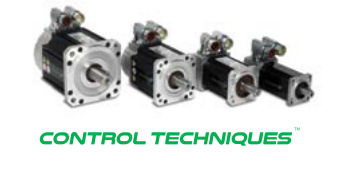
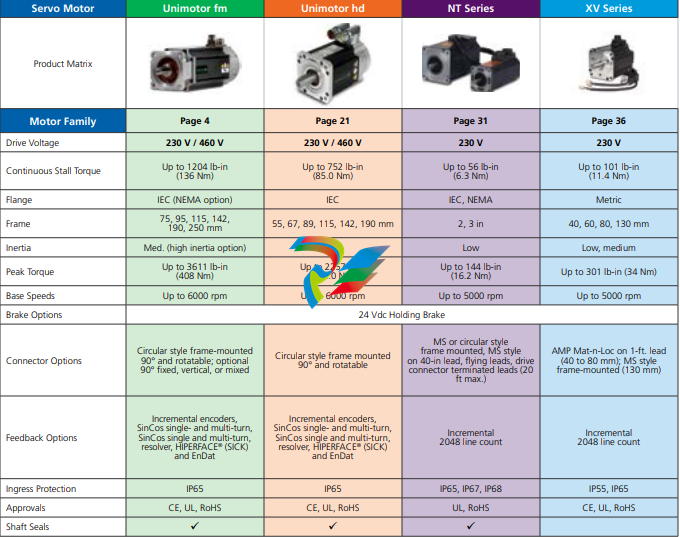
NIDECUnimotor hd, Unimotor fm, NT Series and XV Series 0.9 – 1,204 lb-in (0.11 – 136 Nm) 230 V | 460 V Servo Motors

A Servo Motor for Every Application

Performance Advantage

Unimotor fm

Designed for flexible configuration for use in a wide range of 

applications. A high inertia option is available.

• Voltage Rating: 230 V/460 V

• Continuous Torque: 10.6 to 1,204 lb-in (1.2 to 136 Nm)

• Feedback Choices: Resolver, incremental and absolute 

encoder with multiple connector options

• Frame Sizes (with NEMA flange options): 75, 95, 115,

142 ,190 and 250 mm

• Ratings: IP65, UL, CE and RoHS

Unimotor hd 

Compact low-inertia servo motor for high-dynamic applications

• Voltage Rating: 230 V/460 V

• Continuous Torque: 6.4 to 752 lb-in (0.72 to 85.0 Nm)

• Feedback Choices: Resolver, encoder and absolute encoder

• Frame Sizes: 55, 67, 89, 115, 142 and 190 mm

• Ratings: IP65, UL, CE and RoHS

NT Series

Compact NEMA or metric flange motors

• Voltage Rating: 230 V

• Continuous Torque: 7.5 to 56 lb-in (0.85 to 6.3 Nm)

• Feedback Choices: Incremental encoder 

• Flying Lead Option

• Frame Sizes: English (NEMA 23 or 34) or Metric (IEC-72-1)

• Ratings: IP65, UL and RoHS

XV Series

Economical metric motors

• Voltage Rating: 230 V

• Continuous Torque: 0.9 to 101 lb-in (0.11 to 11.5 Nm)

• Frame Sizes: 40, 60, 80 and 130 mm

• Ratings: IP55 and IP65, UL, CE and RoHS

Shaft seals standard on Unimotor hd, Unimotor fm 

and NT series motors

Reliability and Innovation

Control Techniques designs its products using a proven 

development process that prioritizes innovation and reliability. 

This process has resulted in Nidec’s market-leading reputation for 

performance and quality.

Control Techniques offers a wide range of reliable servo motors 

designed to meet specific application requirements. When 

matched to a Control Techniques’ brand servo drive product 

(Unidrive M, Digitax ST, Epsilon EP or MDS servo drive), the 

resulting drive/motor combination provides an optimized system 

in terms of ratings, performance, cost and ease of use.

Today, businesses of all sizes are searching for partners who 

understand the unique demands of today’s global economy. 

Time and again they turn to Control Techniques. With our 

world-class brands, broad industry experience and extensive 

global presence, Control Techniques is uniquely positioned to 

deliver cost-effective solutions for the ever-changing industrial 

manufacturing market

A Wide Range of Rugged and Reliable Servo Motors

Why Motion Customers Choose Nidec’s Motion Control Solutions..

 A full line of servo motors up to 1200 lb-in

• Single-source motion control lowers total system costs

• Complimentary software offers the ultimate programming 

capability and greatly reduces programming time

• Multiple fieldbus options including EtherCAT, EtherNet/IP, 

Modbus TCP/IP and more

• High-speed, peer-to-peer communications

• 8 feedback types supported as standard

• Integrated programs eliminate need for PLC

• Drive and Automation Center support

• Zero-space internal EMI and dynamic braking resistor options

• AC drives with closed-loop vector control and sensorless

rotor control

Selecting the Right Motor for the Right Drive

Control Techniques’ drive and motor combinations provide an 

optimized system in terms of ratings, performance, cost and 

ease-of-use. You can manually select the system components 

using the following steps, or download the SERVOSoft® sizing 

software which includes our Control Techniques’ servo drive and 

motor data. 

1. Determine the application’s continuous and peak torque 

requirements at various motor shaft speeds, then refer to 

motor data tables and the visual reference overview to help 

determine which motor family will be most appropriate for 

the application.

2. Once the motor family is selected, use this brochure to select 

a specific motor model that delivers the required torque and 

speed. Make note of the continuous and peak current (Amps) 

requirements of the selected motor.

3. Check the specification tables in the Control Techniques’ 

individual drive brochures for Digitax ST, Epsilon EP, Unidrive 

M or MDS servo drives to select the drive model that delivers 

adequate continuous and peak torque for the selected motor.

4. Refer to the Servo Motor Cables section of this brochure to 

select the motor power and feedback cables for the selected 

motor and drive. 

5. Confirm that the ratio of rotor inertia to load inertia is <10:1

load inertia/rotor inertia <10

 Note: A gear reducer will reduce the load inertia based on 

the following equation:

Reflected load inertia = load inertia/gear ratio2

Note: When specifying a motor system, be sure to consider 

such options as user-interfaces (HMI), braking resistors and 

other options and accessories that will enhance the system’s 

performance and value.

Electronic Nameplates

Some motors fitted with high-resolution SinCos or absolute 

encoders are pre-loaded with the motor “electronic nameplate” 

data during the manufacturing process. This data can be 

read by most Control Techniques’ brand servo drives and 

used to automatically optimize the drive settings. This feature 

simplifies commissioning and maintenance, ensures consistent 

performance and saves time

Example

using the NT motor family and Digitax ST servo drive family

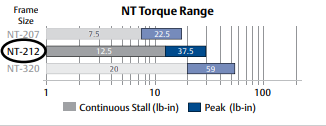
Step 1: The application requires 12 lb-in continuous torque.

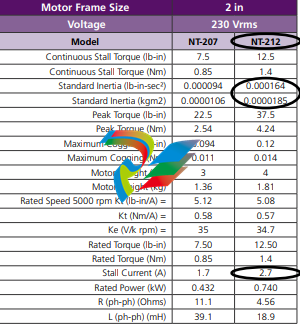
Step 2: The Servo Motors brochure lists the NT-212 motor 

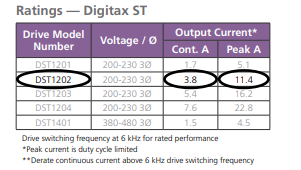
with 2.7 A stall current.

Step 3: Select the Digitax ST drive with adequate current rating.

Unimotor fm 230 V / 460 V

Flexible Configuration AC Servo Motors

Unimotor fm is a high performance, brushless AC Servo 

motor range matched for use with Control Techniques’ brand 

drives. “FM” stands for “Flexible Motor” and is designed to 

accommodate a wide range of applications. The motors are 

available in six frame sizes with various mounting arrangements 

and motor lengths. Control Techniques’ drives and motors are 

designed to function as an optimized system. Unimotor fm is the 

perfect partner for Unidrive M, Digitax ST and Epsilon EP servo 

drives.

Key Features

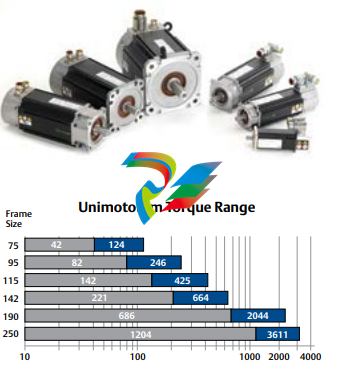
• Torque range: 12.4 to 1204 lb-in (1.4 to 136.0 Nm)

• Medium inertia design with high inertia option available

• Connector styles include vertical, low profile and

90° rotatable

• Variety of flange possibilities (IEC/NEMA)

• Holding brake option

• IP65 conformance

• Winding to suit 230 V and 460 V

• Speed options include 2000, 3000, 4000 and 6000 rpm

• Multiple feedback options:

• Resolver: Robust for extreme applications and

conditions — lower accuracy, medium resolution

• Incremental encoder: High accuracy, medium resolution

• Absolute: Medium accuracy, medium resolution, single-turn 

and multi-turns

• SinCos/Absolute: High accuracy, high resolution, single-turn 

and multi-turn

• HIPERFACE (SICK) and EnDat (Heidenhain) protocols 

supported

NOW WITH EVEN HIGHER PERFORMANCE!

Electronic Nameplate Capability

When a Unidrive M, Unidrive SP or Digitax ST servo drive is 

connected to a SinCos or absolute encoder, it can recognize and 

communicate with the motor to obtain the “electronic nameplate” 

data. This motor data can then be used to automatically optimize 

the drive settings. This feature simplifies commissioning and 

maintenance, ensures consistent performance and saves time.

Unimotor fm Order Information

Your definitive source for quality pre-owned equipment

Full-service, independent repair center 

with experienced engineers and technicians on staff. 

We buy your excess, underutilized, and idle equipment 

along with credit for buybacks and trade-ins. 

Custom engineering 

so your equipment works exactly as you specify. 

• Critical and expedited services • Leasing / Rentals/ Demos 

• In stock/ Ready-to-ship • !TAR-certified secure asset solutions


Control Techniques Dynamics Limited

CT Dynamics is a British company renowned for its

innovations in the industrial servo, aerospace and defence

markets. Founded some 40 years ago it has developed a

leading position by combining two of the UK’s best servo

companies: Moore Reed and the Powerotor Division of

Evershed and Vignoles. CT Dynamics’ experience in the field

of servo and rotating components provides a strong base

from which to develop cost effective solutions for a spectrum

of applications from machine tools, mechanical handling,

pick and place machinery – through to specialised

mechanisms and actuators for the avionics industry.

CT Dynamics is a member of the Emerson group of the USA.

This gives the company access to a vast engineering design

resource in the USA, in the UK and in mainland Europe. As a

result CT Dynamics offers continuous advances in product

range, backed with the expertise and flexibility to meet the

demands of your applications – now and in the future.

Introduction

The Unimotor range has been developed following extensive

research and testing of thermal dynamic theories and

practices.

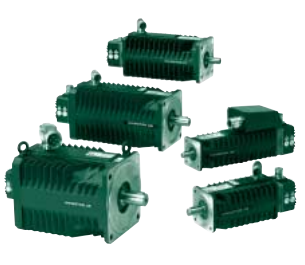
This range is available in five frame sizes 75; 95; 115; 142

and 190mm, in a unique and instantly recognisable finned

design that offers extra strength, rigidity and thermal

performance. These are important features for high

performance servo systems.

Designed to operate from switched-mode three-phase AC

drive outputs with DC link volts up to 750V DC, this range

employs a registered UL approved insulation system.

There are four basic motor types, each for different drives.

UM, SL and DM motors are for 400/440V nominal AC

drive supply voltage.

EZ motors have identical mechanical construction and

feedback options, but support a different winding to suit

220V nominal AC drives such as Unidrive LV and Epsilon /EN

drives.

UM, SL and DM Motors

UM Motor

The UM motor has been primarily designed to operate with

the Unidrive and Unidrive SP, but can be used with any

suitable drive.

Feedback options include resolver; or incremental, sincos

single-turn, sincos multi-turn optical encoders.

SL Motor

The SL version is a UM motor fitted with special SLM

technology electronic feedback that operates with Control

Techniques’ M’Ax and MultiAx drives. This motor-drive

combination offers extremely high resolution, for superb

system speed control. High resolution is essential for many

system applications where speed and position errors must be

miniscule.

The feedback comprises of a special Sincos encoder and SLM

electronics, both contained within the standard UM outline.

The encoder has a memory programmed with all the

essential motor characteristics necessary to automatically set

all M’Ax parameters, giving an instant ‘Plug and Play’

capability

DM Motor

The DM motor is suitable for use with the DigitAx drive. The

stator connections to U and V are interchanged to match the

DigitAx.

Accessories

Other options

Gearboxes – motor torque can be extended by a good

selection of factory-fitted gearboxes, available to order in a

wide variety of options.

Forced air-cooling – customer-fitted fan blown boxes

specially designed to fit the range of motors, can directly

enhance motor performance. (Not suitable for SL).

Custom specials – a range of special adaptations e.g. shaft

or feedback type are already designed and may be available

where quantities justify.

Cable assemblies – ready made power and signal cables in

lengths of 2-100 metres to connect motors to the

appropriate drive

Heat Transfer from Radially 

Finned Motor Housings

One of the most important features of an electric motor is its

rated torque value per unit of motor volume. To maximise this

value, the motor surface must lose heat as efficiently as

possible. Additionally, servo motors must provide full torque

at zero speed. It is not practical to use a shaft mounted fan for

cooling so the motor must keep cool through a combination of

natural convection, conduction through the front flange, and

radiation.

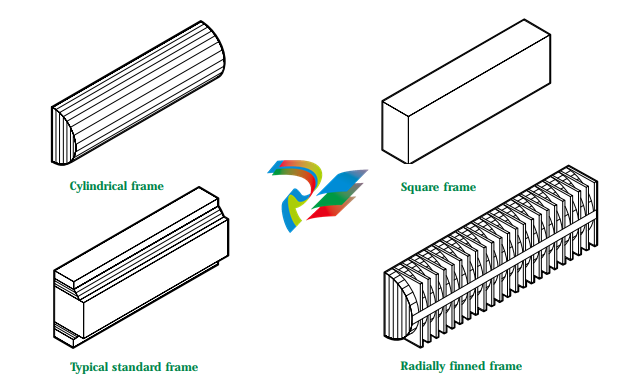
Figure 1. Naturally ventilated motors usually have a relatively smooth

frame surface. The frame is cylindrical or square, or a combination of the

two. The above illustrations show half cross sections of the various motor

types as used in the CFD model

Adding fins to a surface increases the convective cooling –

radiators are an everyday example. Axial fins are common in

forced ventilated motors. CT Dynamics has taken this concept

a stage further to develop the Unimotor range of servo motors.

For a motor to give a performance that requires minimal derating, it must be designed so that it can be mounted in a

number of orientations. The Unimotor’s finned design ensures

that the motors can be mounted horizontally or vertically

without significant effect on heat transfer. CT Dynamics’

engineers derived the optimal fin thickness and spacing using

a specially designed computational fluid dynamics (CFD)

model.

Finned Motors – Designed for Horizontal

and Vertical Orientation

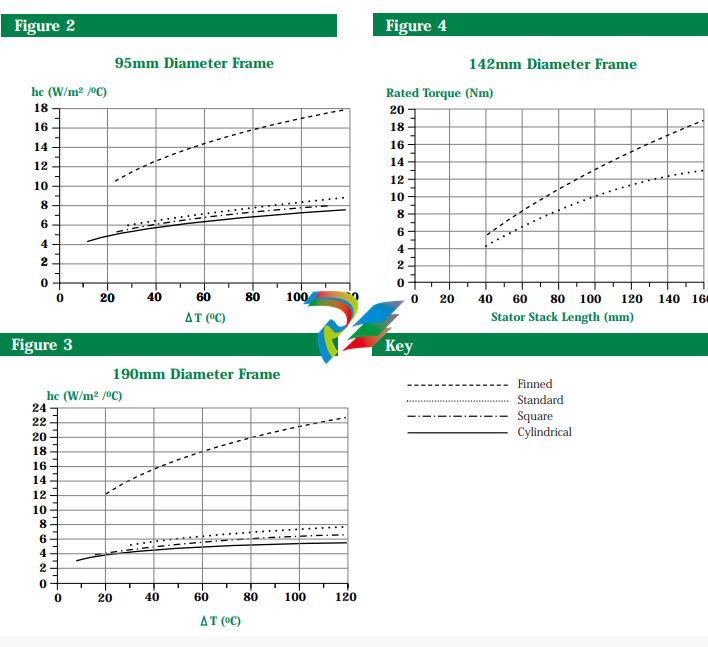
Figures 2 and 3 show charts comparing the variation between

hC (heat transfer coefficient for convection) with ∆T for the

finned motor design against traditional types. The heat

transfer coefficient shows a massive 100% to 200%

improvement over conventional housings.

Figure 4 compares the rated torque of a range of motors with

and without radial finning. The figure takes account of the

effect of any additional conductive cooling through the front

flange and radiation. The additional convection cooling gives

a sizeable increase in torque for the finned motor range. 

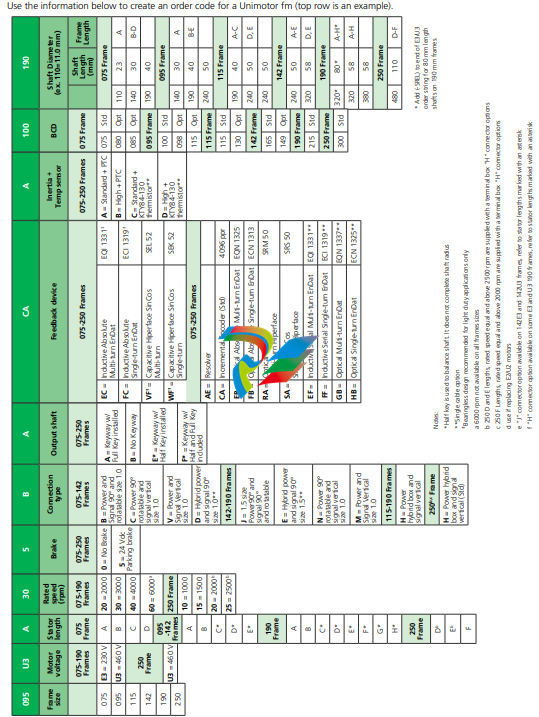
Ordering Information

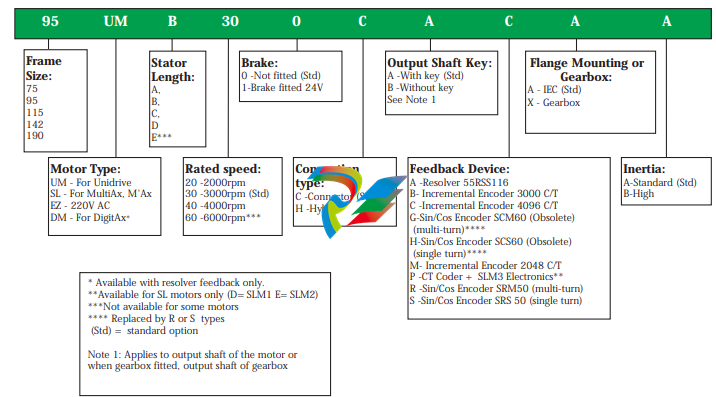
Use the information given in the illustration below to create

an order code for the Unimotor. The details in the green

band are an example of an order code. CT Dynamics

recommends that you order the required mating connectors

at the time of placing your order. For further details turn to the

cables. See also the grid overleaf, which gives standard and

optional features available for each motor. If you are unsure

which motor you need see ‘Selecting the Correct Motor’.

omronSYSMAC CJ-series CJ2M CPU Units, Pulse I/O Modules

Since 2001, CJ1M-series PLCs are in 

control of a wide variety of 

applications worldwide. 

The accumulated experience and 

advancements in technology now 

result in CJ2M; fully compatible, yet 

fully new.

• Increased performance, and increased memory capacity

• Up to 40 I/O unit on any CPU

• Pulse I/O Modules add position control functions to any CPU

• USB for plug-and-play access to the PLC

• All models available with or without Ethernet port

• Choice of serial port plug-in modules

Features

• Five variations in program capacity from 5K steps to 60K steps; scale the CPU to your application needs.

• Faster processors; LD instruction execution time is reduced to 40 ns, floating point trigonometrics in less than 1 μs.

• Optional Pulse I/O Modules can be mounted to enable positioning functions for up to four axes. The module provides high-speed counters, 

interrupt inputs and pulse train/PWM outputs. (CJ2M CPU Units with Unit Version 2.0 or Later) 

• Faster Function Block calls and execution, faster interrupt handling, less overhead time.

• Added execution memory for Function Blocks allows structured, object-oriented programming even in entry-level CPUs.

• General-purpose Ethernet port supports EtherNet/IP tag-based data links, connection to Support Software, communications between PLCs, 

FTP data transfers, and more (CJ2M-CPU3@).

• Standard USB port on all models allows Support Software to connect directly through standard USB cable.

• A Serial Option Module can be mounted to add RS-232C or RS-422A/485 communications ports (CJ2M-CPU3@).

• Compatible with all existing CJ1 power supply-, I/O-, control- and communication units.

Ordering Information

International Standards

• The standards are abbreviated as follows: U: UL, U1: UL (Class I Division 2 Products for Hazardous Locations), C: CSA, UC: cULus, 

UC1: cULus (Class I Division 2 Products for Hazardous Locations), CU: cUL, N: NK, L: Lloyd, and CE: EC Directives.

• Contact your OMRON representative for further details and applicable conditions for these standards.

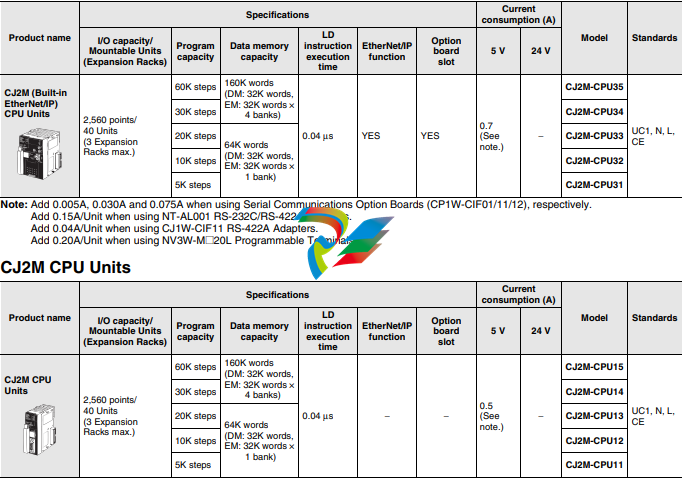
CJ2M CPU Units (Built-in EtherNet/IP)

Note: Add 0.15A/Unit when using NT-AL001 RS-232C/RS-422A Adapters.

Add 0.04A/Unit when using CJ1W-CIF11 RS-422A Adapters.

Add 0.20A/Unit when using NV3W-M@20L Programmable Terminals.

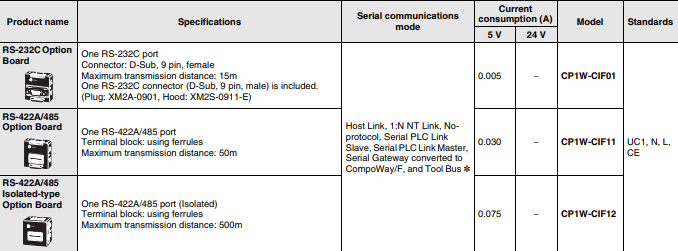
Serial Communications Option Boards (Only CJ2M-CPU3@)

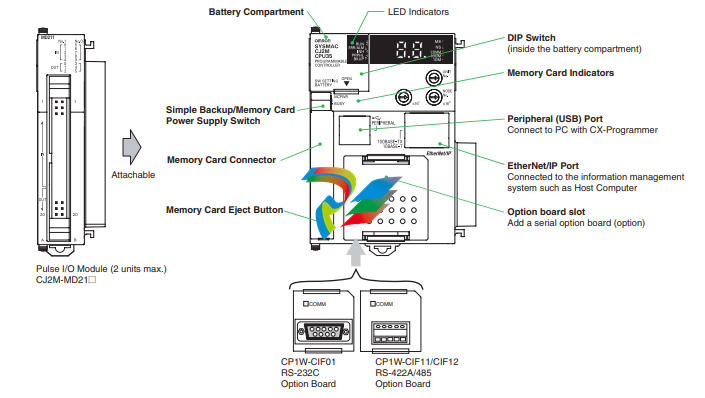
The serial communications port can be equipped by installing the serial communications option board to the option board slot in front of CPU unit.

Note: It is not possible to use a CP-series Ethernet Option Board (CP1W-CIF41), LCD Option Board (CP1W-DAM01) with a CJ2M CPU Unit.

* The following modes cannot be used: 1:1 NT Link, Serial Gateway converted to Host Link FINS, 1:1 Link Master, and 1:1 Link Slave. 

CJ2M-CPU3@/-CPU1@/-MD21@

Pulse I/O Modules (Only CJ2M CPU Unit with Unit Version 2.0 or Later) 

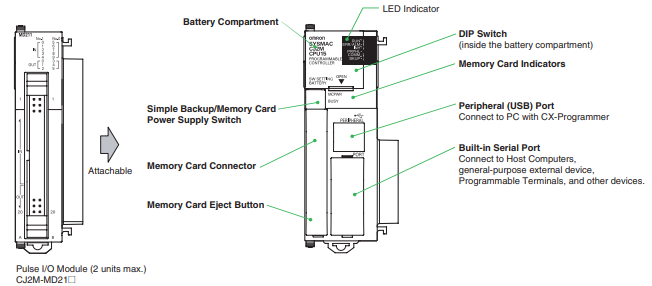
Optional Pulse I/O Modules can be mounted to enable pulse I/O. Up to two Pulse I/O Modules can be mounted to the left side of a CJ2M CPU Unit

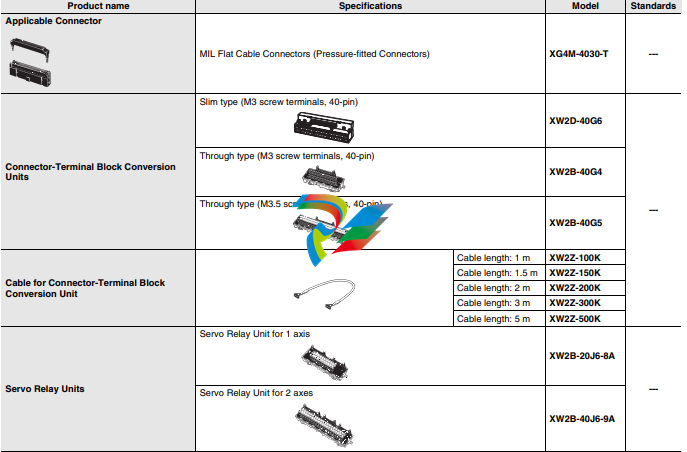
Note: Connectors are not provided with Pulse I/O Modules. Purchase the following Connector, an OMRON Cable with Connectors for Connector 

Terminal Block Conversion Units, or an OMRON Cable with Connectors for Servo Relay Units.

Connecting to Pulse I/O Modules On wiring, refer to Pulse I/O Modules Connector Wiring Methods

External Interface

CJ2M-CPU3@ (CJ2M with Built-in EtherNet/IP)

A CJ2M-CPU3@ provides two communications ports for external interfaces: a peripheral (USB) port and an EtherNet/IP port.

The Pulse I/O functions of the CJ2M can be used by mounting a Pulse I/O Module. Up to two Pulse I/O Modules can be connected to the left side 

of a CJ2M CPU Unit. 

Serial ports can be added by mounting a Serial Communications Option Board (sold separately) in an option slot. 

CJ2M-CPU1@

A CJ2M-CPU1@ provides two communications ports for external interfaces: a peripheral (USB) port and a serial port.

The Pulse I/O of the CJ2M can be used by mounting a Pulse I/O Module. Up to two Pulse I/O Modules can be connected to the left side of a CJ2M 

CPU Unit.

omronSolid-state Timer H3BA-N

Please read and understand this catalog before purchasing the products. 

Please consult your OMRON representative if you have any questions or 

comments. Refer to Warranty and Application Considerations (page 21), 

and Safety Precautions (page 17).

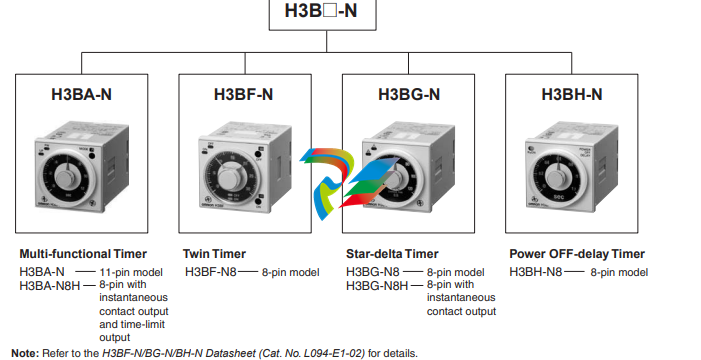
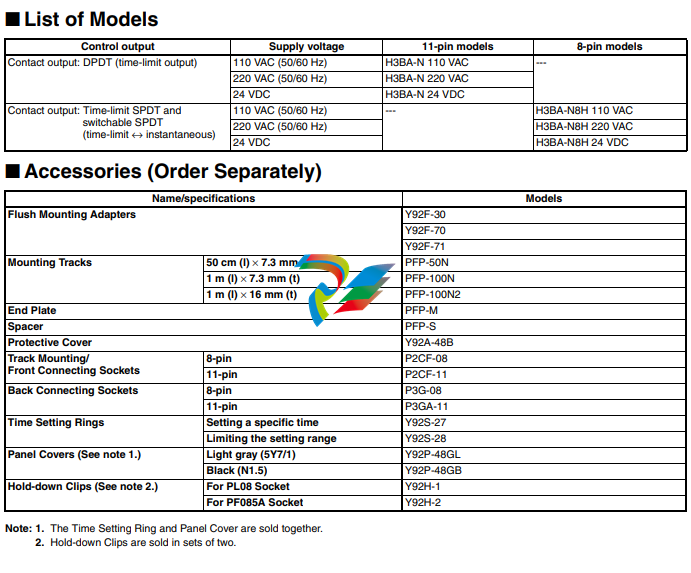
Solid-state Timer with Valuable Multiple-time 

Ranges and Multiple-operating Modes

• Handles a wide range of applications through eight operating 

modes.

• With H3BA-N8H models, the output type can be switched 

between time-limit DPDT and time-limit SPDT + instantaneous 

SPDT using a selector.

• Setting rings (order separately) to enable consistent settings 

and to limit the setting range.

• Panel Covers (order separately) to enable various panel 

designs.

• CE marking.

UL, CSA and CCC certification, conforms to LR.

■ Broad Line-up of H3B@-N Series

Model Number Structure

■ Model Number Legend

1. Number of Pins/Output

None: 11-pin models/Time-limit DPDT

8H: 8-pin models/Time-limit SPDT and switchable SPDT (time-limit ↔ instantaneous)

Ordering Information

■ Basic Setting

Setting of Selector

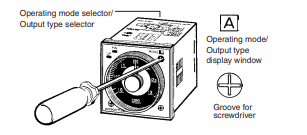
The selectors can be turned clockwise and counterclockwise to 

select the desired time unit, time range, output type (only for H3BAN8H) or operating mode.

Each selector has a snap mechanism that secures the selector at a 

given position. Set the selector at a position at which it is secured. Do 

not set it midway between two securing positions or a malfunction 

could result from improper setting.

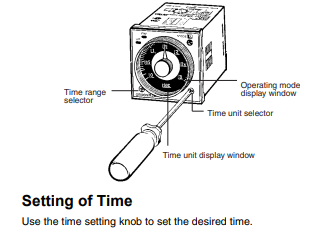
Selection of Operating Mode with H3BA-N Turn the operating mode selector with a screwdriver until the desired operating mode (A, B, B2, C, D, E, G, or J) appears in the display window located above the selector. Selection of Output Type with H3BA-N8H Turn the output type selector with a screwdriver until the desired output type (A or H) appears in the display window located above the selector. Selection of Time Unit and Time Range The desired time unit (sec, 10 s, min, 10 m, hrs, or 10 h) is displayed in the window below the time setting knob by turning the time unit selector located at the lower right corner of the front panel. A time range (1.2, 3, 12, or 30) is selected with the time range selector at the lower left corner of the front panel, and the selected time range appears (in the window at the lower right part) within the plastic frame of the time setting knob.

■ Using the Setting Ring

Setting a Specific Time

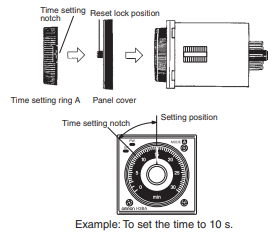
Mount the Panel Cover on the Timer, set the desired time with the 

time setting knob, and place Time Setting Ring A onto the time 

setting knob so that the time setting notch of Time Setting Ring A is 

in the center of the reset lock position of the Panel Cover.

Limiting the Setting Range

Example: To set a range of 10 and 20 s.

Mount the Panel Cover on the Timer, set the time setting knob to 10 s 

(the lower limit of the setting range), and place Time Setting Ring C 

onto the time setting knob so that the stopper of Time Setting Ring C 

is on the right edge of the reset lock position of the Panel cover. Next, 

set the time setting knob to 20 s (the upper limit of the setting range), 

place Time Setting Ring B onto the time setting knob so that the 

stopper of Time Setting Ring B is on the left edge of the reset lock 

position of the Panel Cover.

Read and Understand this Catalog

Please read and understand this catalog before purchasing the product. Please consult your OMRON representative if you have 

any questions or comments. 

Warranty and Limitations of Liability

WARRANTY

OMRON’s exclusive warranty is that the products are free from defects in materials and workmanship for a period of one year 

(or other period if specified) from date of sale by OMRON.

OMRON MAKES NO WARRANTY OR REPRESENTATION, EXPRESS OR IMPLIED, REGARDING NON-INFRINGEMENT, 

MERCHANTABILITY, OR FITNESS FOR PARTICULAR PURPOSE OF THE PRODUCTS. ANY BUYER OR USER 

ACKNOWLEDGES THAT THE BUYER OR USER ALONE HAS DETERMINED THAT THE PRODUCTS WILL SUITABLY MEET 

THE REQUIREMENTS OF THEIR INTENDED USE. OMRON DISCLAIMS ALL OTHER WARRANTIES, EXPRESS OR 

IMPLIED. 

LIMITATIONS OF LIABILITY

OMRON SHALL NOT BE RESPONSIBLE FOR SPECIAL, INDIRECT, OR CONSEQUENTIAL DAMAGES, LOSS OF PROFITS 

OR COMMERCIAL LOSS IN ANY WAY CONNECTED WITH THE PRODUCTS, WHETHER SUCH CLAIM IS BASED ON 

CONTRACT, WARRANTY, NEGLIGENCE, OR STRICT LIABILITY. 

In no event shall the responsibility of OMRON for any act exceed the individual price of the product on which liability is asserted. 

IN NO EVENT SHALL OMRON BE RESPONSIBLE FOR WARRANTY, REPAIR, OR OTHER CLAIMS REGARDING THE 

PRODUCTS UNLESS OMRON’S ANALYSIS CONFIRMS THAT THE PRODUCTS WERE PROPERLY HANDLED, STORED, 

INSTALLED, AND MAINTAINED AND NOT SUBJECT TO CONTAMINATION, ABUSE, MISUSE, OR INAPPROPRIATE 

MODIFICATION OR REPAIR. 

Application Considerations

SUITABILITY FOR USE

OMRON shall not be responsible for conformity with any standards, codes, or regulations that apply to the combination of the 

product in the customer’s application or use of the product.

Take all necessary steps to determine the suitability of the product for the systems, machines, and equipment with which it will 

be used. 

Know and observe all prohibitions of use applicable to this product.

NEVER USE THE PRODUCT FOR AN APPLICATION INVOLVING SERIOUS RISK TO LIFE OR PROPERTY WITHOUT 

ENSURING THAT THE SYSTEM AS A WHOLE HAS BEEN DESIGNED TO ADDRESS THE RISKS, AND THAT THE OMRON 

PRODUCT IS PROPERLY RATED AND INSTALLED FOR THE INTENDED USE WITHIN THE OVERALL EQUIPMENT OR 

SYSTEM.

PROGRAMMABLE PRODUCTS 

OMRON shall not be responsible for the user’s programming of a programmable product, or any consequence thereof.

Disclaimers

CHANGE IN SPECIFICATIONS 

Product specifications and accessories may be changed at any time based on improvements and other reasons. Consult with 

your OMRON representative at any time to confirm actual specifications of purchased product.

DIMENSIONS AND WEIGHTS 

Dimensions and weights are nominal and are not to be used for manufacturing purposes, even when tolerances are shown.

PERFORMANCE DATA 

Performance data given in this catalog is provided as a guide for the user in determining suitability and does not constitute a

warranty. It may represent the result of OMRON’s test conditions, and the users must correlate it to actual application 

requirements. Actual performance is subject to the OMRON Warranty and Limitations of Liability

omronCREATE AND OPERATENQ HMI series

Powerful, colour HMI

in a compact format

The NQ series, Omron’s family of easy to use 

economic HMI terminals, offers you many 

useful features, with the best quality 

graphical display in even the smallest touch 

screen. This makes the NQ family ideal for 

many different applications, from a simple 

semi-automatic packaging machine up to a 

bigger in-line packaging or filling machine.

More functionality and flexibility

at no extra cost

The smallest version of the NQ series is ideal in places 

where operators are currently using pushbuttons and 

lamps, or text based function-key terminals, by offering 

more functionality and flexibility without increasing 

overall costs. The NQ touch screen gives you the 

functionality to create intuitive screens for the operator 

with ready-to-use buttons and lamps from the library, 

alarm handling and even trending and logging of 

historical data. 

The colour displays ensure you get the full benefits of 

the NQ HMI series’ functionality, as the clarity and 

brightness of the screen make the coloured status 

alarms ‘jump out’ to clearly inform the operator.

As well as the use of the touch screen, the operator can use 

the 5 or 6 function keys for commonly used functions 

throughout the HMI application. 

Updating the HMI application or uploading historical data 

from the NQ can be done easily and quickly with a standard 

USB stick. This means that you can supply the new HMI 

application to the end user for on-site updating.

All the NQ HMI family models come with many features for fast 

creation of modern looking applications. The USB ports allow 

easy connection and data transfer between the HMI and PC, 

while the serial communication ports enable connection to 

many popular devices for the exchange and display of data.

As well as the large family of Omron PLCs, the NQ HMI can also 

interface with a wide range of non-Omron devices by 

supporting dedicated and open communication protocols.

Create modern applications easier and faster

Texts can be defined in nine different languages with support 

for Latin, Cyrillic, and Asian characters. Furthermore, the real 

time clock and the graphical features, like analogue meters 

and bar graphs, mean that you can upgrade the functionality 

of machines with ordinary switches or buttons. 

Alarms are shown in real time and can be printed, while 

historical data can be displayed as a trend, or uploaded in

CSV format.

Diversity for flexibility

The NQ series comes in different display sizes and in a colour 

and monochrome version. All of them display clear and sharp 

pictures, buttons, text and graphs on a modern touch screen.

All versions have two USB ports and in addition to the touch 

screen, a minimum of five function keys on the right side, 

which enable quick activation of the most commonly used 

functions. 

Connectivity

The NQ HMI can connect in many different ways using Serial 

connection, Ethernet connections and USB. With these 

physical connections and the many protocol drivers 

available, you can communicate to many different Omron and 

non-Omron devices, like PLCs, inverters and temperature 

controllers. The NQ HMI collects all the data and can quickly 

visualize it graphically. Data stored in the NQ HMI can be 

easily transferred to a memory stick or PC.

With all these possibilities the NQ HMI gives you the choice 

to create from where and how you want to gather data, so 

that operation of your machine is easy and intuitive.

Ethernet

The NQ TFT colour models are equipped with an Ethernet port 

that support communication to several Omron PLCs and can 

also be used for up-/downloading of project data. Using the 

default settings like the IP-address, you can immediately 

connect with Ethernet to quickly download your created 

project.

The Omron Ethernet FINS protocol even makes it possible to 

read and write data memory inside the NQ HMI from PC 

applications so that any data can be shared easily.

Language support

Texts can be defined in nine different 

languages with support for Latin, Cyrillic, and 

Asian characters.

Quality display

With the NQ software you can easily design 

beautiful screens, showing buttons and sharp 

colour graphics. 

Easy project updates

All NQ versions have two USB ports for easy 

project updates using a simple USB stick or 

USB cable. 

Quickly accessible functions 

In addition to the touch screen, a minimum of 

five function keys on the right side enable 

quick activation of the most frequently used 

functions. 

Landscape and portrait model

The NQ 5.7 inch version, both colour and 

monochrome, is available in a portrait and 

landscape model and can therefore be 

installed in places where space is limited. 

Trending and logging

Plotted trend graphs can be displayed for a 

graphical representation of data. The trend 

can show real time and historical (logged) 

data with a time-based axis. 

Alarm handling

Alarms are shown on the screen with their 

actual status and text message. For each 

alarm you can define the condition, priority 

and whether it needs to be logged, so that 

you can create a history of occurred alarms. 

Conversion

It is always possible to convert your NQ 

project to any model within the NQ series

Simple software that has it all

The NQ Series has all the features needed for creating modern 

looking applications. Mastering the software requires little 

training and the library includes all the basic HMI functions 

plus extra buttons, lamps, graphics, and meters, including 

real-time and historical trending and logging.

NQ-Designer configuration software makes it easy to create 

your HMI application. It guides you from start to setup of your 

HMI project, creating nodes, tags and screens. For screens, 

you can create pop-up, template and keypad screens. Per 

screen, you can define the function keys and perform certain 

tasks, like calculations or read/write actions. Your project can 

also be tested directly on the PC with this easy to use 

Windows look & feel software

OrmecSMLC System Overview

Motion and Logic. All in

one. You can 

combine the best of 

both worlds with 

IEC 61131-3 

programming tools 

and powerful 

motion control 

software for up to 

16 axes.

ORMEC’s 

ServoWire Motion & Logic 

Controller (SMLC) product family 

provides integrated, costeffective control that leverages 

industry-standard hardware and 

software solutions.

Reduce your software 

development and support costs

by using the common “look and 

feel” of our CoDeSys software 

solution for programming 

applications using sequential 

function chart, relay ladder

logic, function block diagrams, 

instruction list and structured 

text. Use the PLCopen motion 

control library, Application 

Specific Function Blocks and

powerful ORMEC extensions 

for electronic gearing, 

camming, registration control, 

superimposed motion and 

coordinated, 

for multi-axis 

applications.

Check out our 

line-up of 

FireWirebased digital drives and servo

motors, and solutions for machine 

I/O, factory networking and HMI.

IEC 61131-3 programming and 

high performance motion for 

up to 16 axes in a single 

package.

Up to 16 servos can be daisychained and interfaced to the 

SMLC using standard IEEE1394b network interfacing and 

cabling.

Machine I/O solutions include 

Ethernet or Profibus DP.

Quality AC brushless 

servomotors offer continuous 

stall torques from 3 to 845 lbin (0.32-75 N-m)

Fully Integrated Total System Solutions…

ORMEC Systems Corp. | 19 Linden Park | Rochester, NY 14625 | phone (585) 385-3520 |www.ormec.com

Integrated Control Hardware

The ServoWire® Motion and Logic Controller

The SMLC is a cost-effective control platform offering 

rugged, industrial hardware, a proven RTOS and industry 

standard networking, programmed using standard IEC 

61131-3 languages. An SMLC system offers low cost, 

compact, proven and reliable components.

Featuring Pentium-class processors.

Two built-in Ethernet ports, two or three FireWire 

ports* (with or without screw downs), three or four 

serial ports*. 

Compact Flash program storage (eliminates hard 

disk) and 32k battery-backed SRAM data storage.

Reliable, QNX real-time operating system. 

*Model Dependent

CoDeSys Development Software

Using industrystandard IEC 

61131-3, you can 

develop a motion 

and I/O program 

using standard 

tools that 

streamline 

development and 

create application 

solutions that are 

both more effective and easier to support in the field. 

There are no software costs when using the ORMEC 

SMLC in your application. 

FireWire motion networking reduces cost & 

complexity

Control one to 16 servos directly from one controller 

without specialized motion control hardware. 

ServoWire® S2D drives are available in 200V and 

400V series. Fourteen models provide continuous 

output power from 600 watts to 24 kilowatts,

Conveniently interface a variety of Servo Motors

Mix and match servo technologies (DC brushless rotary, linear, 

DC brush-type or voice coil motors) in the same drive hardware. 

Continuous stall torques from 3 to 665 lb-in (0.32-75 N-m).

Standalone touchscreen HMIs utilize Modbus RTU 

(Serial) or Modbus/TCP (Ethernet) communications. Or 

you can utilize Windows-based HMIs such as 

Wonderware InTouch, Rockwell Automation RS View, 

Intellution iFIX, CiTect or GE Cimplicity that communicate 

with the SMLC using an OPC Server.

Select among text-based and graphical languages 

to pick the right one for the job — Relay Ladder 

Logic, Function Block Diagram, Structured Text, 

Instruction List or Sequential Function Chart 

programming. 

Program motion control and logic using standard 

IEC 61131-3 tools. 

Suite of programming languages and diagnostic 

tools streamlines development and simplifies 

support.

PLCopen standard Motion Control Library, plus

powerful ORMEC extensions, bring new levels of 

motion performance for electronic gearing, 

camming, registration control and coordinated, 

multi-axis applications

Application Specific Function Blocks are provided 

for many common motion control applications.

ServoWire® Motion & Logic Controller

Models 30, 80 & 160

ORMEC’s ServoWire Motion & Logic 

Controller (SMLC) is at the center of a 

complete machine control solution that 

can meet all of your motion, I/O and 

networking needs. By combining 

Pentium processors, IEEE 1394b 

FireWire drive networking and Ethernet 

connectivity, the SMLC is a system that 

can control your entire machine. This 

allows you to focus on your application 

instead of integrating control 

components.

The SMLC, ServoWire Drive Network, 

Modbus/TCP and Ethernet IP provide 

state-of-the-art I/O and motion control 

(for up to 16 axes), all programmed 

using any of the five IEC 61131-3 

standard languages including relay 

ladder logic.

SMLC Family of Controllers

The ServoWire Motion & Logic 

Controller (SMLC) family features high 

performance computing capability 

combined with a true real-time 

operating system (RTOS). Using the 

industry standard family of Intel 32-bit 

processors running the QNX RTOS 

provides plenty of cost effective, robust 

computing power for even the most 

demanding multi-axis motion control 

and machine control applications.

Machine I/O

The SMLC provides a multi-tiered, 

flexible approach to meeting machine 

I/O requirements. It has the ability to 

interface high-speed drive based I/O 

for microsecond position capture and 

single servo update response to sensor 

signals. It also provides submillisecond programmable limit switch 

outputs that are tightly coupled to the 

motion control.

General purpose I/O options are fully 

supported using WAGO 750 Series 

Ethernet I/O as well as optional 

Profibus DP Master support. For both 

options, a wide variety of analog and 

digital I/O modules can be cost 

effectively connected to and controlled 

by the SMLC.

SMLC 

1. Processor Options

Intel architecture microprocessor

128 Mbytes DRAM

128 Mbytes of FLASH memory for 

program storage

32 Kbytes SRAM (battery packed) 

for non-volatile data storage

2. Communication Ports

Two or three IEEE 1394b 

ServoWire (FireWire) Ports

Two Ethernet Communication 

Ports.

Three RS-232 Communication 

Connectors.

3. Input Power Supply

115/230 VAC input power (autoranging), 50/60 Hz

+5, +/-12 VDC logic power output

4. Status LEDs

Eight status LEDs on the face for 

indicating system status.

ServoWire Drive Network

ORMEC’s AC brushless servomotors 

and ServoWire digital ServoDrives

offer tested and guaranteed 

performance with the SMLC. The 

result is maximum performance from a 

tightly integrated, pre-engineered 

package that simplifies everything 

from system integration to 

maintenance.

Fully digital control offers compelling 

benefits eliminating manual 

ServoDrive setup and providing realtime software access to all 

parameters. In an SMLC system, the 

position, velocity and torque loops are 

all closed by the digital signal 

processors (DSPs) in the ServoWire 

Drives. Position update commands

are sent from the SMLC. Velocity 

observer software eliminates the need 

for analog tachometers, and 

potentiometers are eliminated since all 

gain and compensation parameters 

are set in software.

All loop adjustments are automatically

computed when a motor and its load 

inertia are specified in ServoWire Pro

greatly simplifying servo system 

tuning.

SMLC — At a Glance 

Powerful and Robust: Intel 32-bit 

processors running the QNX RTOS.

IEC 61131-3 Application 

Programming: International 

programming standard for PLCs.

PLCopen Motion Blocks: Standard 

compliant motion blocks, powerful 

ORMEC enhancements.

ServoWire: High-bandwidth, 

synchronous, all-digital ServoDrive

network based on IEEE 1394b.

Networking Options: Modbus/TCP,

OPC Server and Ethernet IP.

I/O Options: WAGO 750 Series 

Ethernet I/O and Profibus DP Master.

Size: Models 30 and 80 are 2.75” x 

7.2” x 9” (w x d x h) and Model 160 is 

4.25” x 7.2” x 9”

Specifications

General Specifications

Input Voltage: 115/230 VAC, 

1.0/0.5A (+15%, -20%), 50/60 Hz

Operating Temperature: 0 to 50°C

Relative Humidity: 10 to 95% @ 

40C (non-condensing)

Weight: Approx. 3.1/3.5 lbs 

Dimensions: Models 30 & 80 are 

2.75” x 7.2” x 9.0” (69.9 x 182.9 x 

228.6 mm), and Model 160 is 4.25” 

x 7.2” x 9.0” (108 x 182.9 x 228.6 

mm) (w x d x h)

Processor & Memory

DRAM: 128 Mbytes

Program Memory: 128 Mbytes 

(Removable Compact Flash)

Non-Volatile Memory: 32 Kbytes 

(battery backed).

Motion Control

All-digital control algorithms 

featuring velocity and acceleration 

feed-forward for optimal 

performance.

High-speed sensor inputs to initiate 

motion within one position command 

update.

High-speed hardware position 

capture is <1 µsec, ideal for use in 

high-speed registration applications.

Software controlled position, speed 

and current (torque) limits.

Drive fault protection circuits, 

watchdog timers and integrated 

diagnostics for fail-safe operation.

Full 32-bit position count or modulo 

position in user units.

SMLC Model 30 – 3 axes

SMLC Model 80 – 8 axes

SMLC Model 160 – 16 axes

Equal number of ‘virtual’ axes for each 

model

SMLC Mounting Diagrams

Inputs/Outputs

SMLC I/O: 8 inputs, 8 outputs, 1 

analog in, 1 analog out.

General I/O: 64 modules per WAGO

750 Series bus coupler, up to 512 

I/O points connected via Ethernet 

(Modbus/TCP). Multiple bus 

couplers can be used for additional 

I/O.

Profibus DP Master (optional) 

supports up to 126 I/O nodes.

Communications

Standard RS-232 serial ports

Standard Ethernet ports support

Modbus TCP/IP or Ethernet/IP.

P+FFrequency Converter with Trip Values

Features

• 1-channel signal conditioner

• 24 V DC supply (Power Rail)

• Input for 2- or 3-wire sensors, NAMUR sensors or dry 

contacts

• Input frequency 1 mHz … 10 kHz

• Current output 0/4 mA … 20 mA

• Relay contact and transistor output

• Start-up override

• Line fault detection (LFD)

• Up to SIL 2 acc. to IEC 61508/IEC 61511

Function

This signal conditioner provides the isolation for nonintrinsically safe applications.

The device is a universal frequency converter that changes a 

digital input signal into a proportional free adjustable 

0/4 mA … 20 mA analog output signal and functions as a 

switch amplifier and a trip alarm.

The functions of the switch outputs (2 relay outputs and 

1 potential free transistor output) are easily adjustable [trip 

value display (min/max alarm), serially switched output, pulse 

divider output, error signal output].

The device is easily configured by the use of keypad or with 

the PACTware configuration software.

A fault is signalized by LEDs acc. to NAMUR NE44 and a 

separate collective error message output.

For additional information, refer to the manual and 

www.pepperl-fuchs.com.

General specifications

Signal type Digital Input

Functional safety related parameters

Safety Integrity Level (SIL) SIL 2

Supply

Connection terminals 23+, 24- or power feed module/Power Rail

Rated voltage Ur 20 … 30 V DC

Rated current Ir approx. 100 mA

Power dissipation/power consumption ≤ 2 W / 2.2 W

Interface

Programming interface programming socket

Input

Connection side field side

Connection Input I: 2-wire sensor: terminals 1+, 3- three wire sensor: terminals 1+, 2- and 3 

input II: terminals 13+, 14- start-up override;

Input I 2- or 3-wire sensor, sensor acc. to EN 60947-5-6 (NAMUR) or mechanical contact

Open circuit voltage/short-circuit 

current 

22 V / 40 mA

Input resistance 4.7 kΩ

Switching point/switching hysteresis logic 1: > 2.5 mA ; logic 0: < 1.9 mA

Pulse duration > 50 µs

Input frequency 0.001 … 10000 Hz

Line fault detection breakage I ≤ 0.15 mA; short-circuit I > 4 mA

Input II startup override: 1 … 1000 s, adjustable in steps of 1 s

Active/Passive I > 4 mA (for min. 100 ms) / I < 1.5 mA

Open circuit voltage/short-circuit 

current 

18 V / 5 mA

Output

Connection side control side

Connection output I: terminals 10, 11, 12

output II: terminals 16, 17, 18

outout III: terminasl 19+, 20-

output IV: terminals 8+, 7-

Output I, II signal, relay

Contact loading 250 V AC / 2 A / cos φ ≥ 0.7 ; 40 V DC / 2 A

Mechanical life 5 x 10⁷ switching cycles

Energized/De-energized delay approx. 20 ms / approx. 20 ms

Output III electronic output, passive

Contact loading 40 V DC

Signal level 1-signal: (L+) -2.5 V (50 mA, short-circuit/overload proof) 

0-signal: blocked output (off-state current ≤ 10 µA)

Output IV analog

Current range 0 … 20 mA or 4 … 20 mA

Open loop voltage ≤ 24 V DC

Load ≤ 650 Ω

Fault signal downscale I ≤ 3.6 mA , upscale ≥ 21.5 mA (acc. NAMUR NE43)

Collective error message Power Rail

Transfer characteristics

Input I 

Measurement range 0.001 … 10000 Hz

Resolution 0.1 % of the measurement value , ≥ 0.001 Hz

Accuracy 0.1 % of the measurement value , > 0.001 Hz

Measuring time < 100 ms

Influence of ambient temperature 0.003 %/K (30 ppm)

Output I, II 

Response delay ≤ 200 ms

Output IV 

Resolution < 10 µA

Accuracy < 20 µA

Influence of ambient temperature 0.005 %/K (50 ppm)

Galvanic isolation

Input I/other circuits reinforced insulation according to IEC/EN 61010-1, rated insulation voltage 300 Veff 

Output I, II/other circuits reinforced insulation according to IEC/EN 61010-1, rated insulation voltage 300 Veff 

Mutual output I, II, III reinforced insulation according to IEC/EN 61010-1, rated insulation voltage 300 Veff 

Output III/power supply and collective 

error 

basic insulation according to IEC/EN 61010-1, rated insulation voltage 50 Veff

Output III/IV basic insulation according to IEC/EN 61010-1, rated insulation voltage 50 Veff

Output IV/power supply and collective 

error 

functional insulation acc. to IEC 62103, rated insulation voltage 50 Veff

Start-up override/power supply and 

collective error 

functional insulation acc. to IEC 62103, rated insulation voltage 50 Veff

Interface/power supply and collective 

error 

functional insulation acc. to IEC 62103, rated insulation voltage 50 Veff

Interface/output III basic insulation according to IEC/EN 61010-1, rated insulation voltage 50 Veff

Indicators/settings

Display elements LEDs , display

Control elements Control panel

Configuration via operating buttons 

via PACTware

Labeling space for labeling at the front

Directive conformity

Electromagnetic compatibility 

Directive 2014/30/EU EN 61326-1:2013 (industrial locations)

Low voltage 

Directive 2014/35/EU EN 61010-1:2010

Conformity

Electromagnetic compatibility NE 21:2006

Degree of protection IEC 60529:2001

Ambient conditions

Ambient temperature -20 … 60 °C (-4 … 140 °F)

Mechanical specifications

Degree of protection IP20

Connection screw terminals

Mass 300 g

Dimensions 40 x 119 x 115 mm (1.6 x 4.7 x 4.5 inch) , housing type C3

Mounting on 35 mm DIN mounting rail acc. to EN 60715:2001

Data for application in connection 

with hazardous areas

Certificate PF 08 CERT 1216 X

Marking ¬ II 3G Ex nA nC IIC T4 Gc

Output I, II 

Contact loading 50 V AC/2 A/cos φ > 0.7; 40 V DC/1 A resistive load

Ambient conditions 

Ambient temperature -20 … 50 °C (-4 … 122 °F)

Directive conformity 

Directive 2014/34/EU EN 60079-0:2012+A11:2013 , EN 60079-15:2010

International approvals

UL approval E223772

Search for products

Back to Top
Product has been added to your cart